
2026 report from Equal Rights Advocates
This report was written by Rukku Singla and drafted with the support of the Ford Foundation. Thanks to Connie Ashbrook, Celina Barron, Beth Berendsen, Abdu Dahr, Janelle DeJan, Jess Eagle, Melvina Ford, Juan Granado, Ariane Hegewisch, Nena Hernandez, Tamara Howard, Erin Johansson, Allie Perez, Nicole Schwartz, Elyse Shaw, Jessica Stender, and Marina Zhavoronkova for their contributions to this report.
Women, and especially women of color, remain dramatically underrepresented in high-paying infrastructure, clean energy, and manufacturing jobs. For example, currently, women make up only about 4.3% of workers in construction trades occupations and face persistent barriers to entry, retention, and safety on the job, including high rates of harassment and discrimination.
The lack of representation of women in these high paying sectors is one contributor to the longstanding gender pay gap in the United States, in which women overall are paid only about 84 cents for every dollar paid to men. The gap is even wider for women of color—Black women earning around 64 cents and Latinas around 57 cents for every dollar paid to white, non-Hispanic men.
 Historic federal investments from the Infrastructure Investment and Jobs Act, the Inflation Reduction Act, and the CHIPS and Science Act had the potential to move women out of low-wage work and into careers offering family-sustaining wages. In response, alongside tradeswomen and other community partners, Equal Rights Advocates (ERA) helped build and lead a national coalition of advocates that coordinated strategy, technical assistance, and enforcement efforts across states including Texas, Arizona, Colorado, Georgia, and Ohio, anchored in part by mechanisms like the Department of Labor’s Megaprojects and Women in Apprenticeship and Nontraditional Occupations (WANTO) programs and partnerships with organizations such as Texas Women Work / Texas Women in Trades (TexWIT), YWCA Columbus, Fresh Start Women’s Foundation, the National Taskforce on Tradeswomen’s Issues (TWTF), and the Houston Gulf Coast Building and Construction Trades Council.
But beginning in early 2025, a change in federal administration dramatically altered this landscape. The elimination of the Megaprojects program and broader cuts to workforce and clean energy programs disrupted years of coalition-building and put hard-won community gains at risk. Yet ERA’s experience shows that organizations with deep state and local partnerships were far better positioned to adapt, pivoting toward state and local procurement policies and sustaining momentum even as federal support receded. This report details ERA’s coalition building work, key partnerships, and lessons learned, and closes with eight recommendations for a more durable path forward, including sustained investment in coalitions, enforceable job quality and non-discrimination standards, adequately resourced federal enforcement and grant-making agencies, and the reinstatement of a strengthened Megaprojects program, to ensure that the next wave of infrastructure and technology investment, including the emerging AI and data center boom, delivers genuine economic opportunity for all.
Advocates and organizers, all levels of governments, philanthropy, unions, and the private sector all have a role to play in ensuring that women can access and thrive in higher paying infrastructure jobs. Below are recommendations for sustained investments and persistent legal protections that outlast political shifts:
1. Invest in coalition building.
Deepen and broaden coalitions like the Coalition to Advance Workforce Equity (CAWE), connecting national strategy to local power and funding under-resourced community organizations so they can participate fully.
2. Invest in equitable workforce development.
Fund pipeline programs that prepare women and workers of color for construction and manufacturing careers.
3. Provide wraparound supports.
Pair workforce programs with childcare, transportation, housing, and other assistance so workers can access and stay in these jobs.
4. Tether federal funding to enforceable standards.
Require living wages, benefits, safety, and worker voice as conditions of federal financial assistance for major projects.
5. Codify non-discrimination
requirements.
Enact statutory requirements for federal contractors to replace those lost with the revocation of Executive Order 11246.
6. Resource federal enforcement
agencies.
Fully fund OFCCP, EEOC, WHD, OSHA, the Women’s Bureau, and agency civil rights offices so existing protections can actually be enforced.
7. Resource federal agencies for swift
fund distribution.
Provide staffing and flexible hiring authority so infrastructure dollars move quickly into communities and job pipelines.
8. Reinstate and expand the OFCCP Megaprojects program.
Restore the program, require participation from large-scale federally funded construction projects over $35 million, and give OFCCP the capacity to oversee more projects.
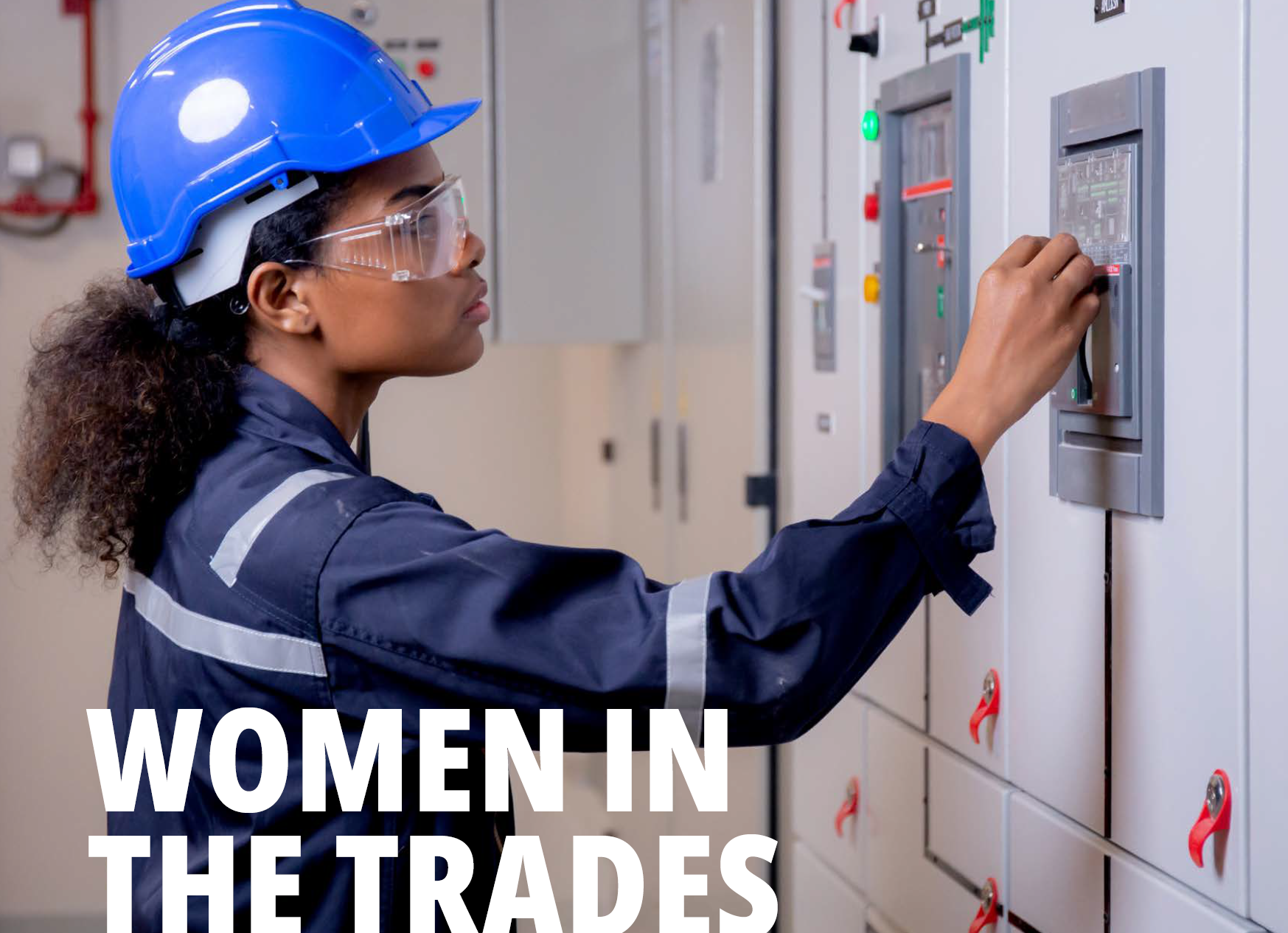
Women, and especially women of color, are steered and segregated into low wage jobs, keeping millions of women and families stuck in a perpetual state of poverty. The largest, measurable contributor to wage injustice is occupational segregation, which accounts for 30 to 40% of the gender pay gap, particularly for women of color. Women—disproportionately women of color— are segregated into low-paying jobs such as retail sales, home health care, service industries, and child care. Currently, women make up two-thirds of the adult minimum wage workforce.
The Biden Harris Administration’s Investing in America Agenda—the passage of the most transformative federal economic legislation in a generation with the Infrastructure Investment and Jobs Act (IIJA), the Inflation Reduction Act (IRA), and the Creating Helpful Incentives to Produce Semiconductors (CHIPS) and Science Act—promised to disburse more than a trillion dollars into states and local governments across the country. Specifically, the IIJA alone invested $1.2 trillion over 10 years in historic new investments in transportation, communications, clean water and energy, and more, and was estimated to add nearly 800,000 jobs to the economy annually. The IRA allocated $369 billion over 10 years for clean energy production, climate solutions, and environmental justice. The CHIPS and Science Act authorized $52.7 billion over 10 years to encourage the construction of semiconductor manufacturing facilities, boosting the nation’s science and technology base and bolstering national and economic security. These laws had the potential to create millions of new jobs and to balance the American workforce, by moving low wage working women into good jobs with family-sustaining wages.
of the gender
pay gap is
affected by
occupational
segregation
The scale of economic opportunity these laws represented for women is striking. Over the course of her lifetime, a woman working as an electrician will make on average $1 million more than a woman working in a traditionally female-dominated job, such as a job in retail, childcare, or service industry. Yet today, women make up just 11% of all workers in the construction industry — and that figure includes lower-paid office and clerical positions. In the construction trades, women account for only about 4.3% of workers, representing roughly 370,000 women working in the highest-paying construction trades careers. Women are similarly underrepresented in clean energy and semiconductor manufacturing industries: women represent 47% of the national workforce but only 25% of the energy workforce, and roughly threequarters of the semiconductor manufacturing workforce is male. Without intentional intervention, the status quo was projected to persist: women would account for only 29% of jobs that were projected to be created by the IIJA (prior to the cancellations and changes introduced by the new federal administration). Black women would account for less than 4% of those new jobs, and Latinas less than 5%. This means America’s infrastructure workforce would remain overwhelmingly white and male, a reflection of deep inequities in current hiring, training, and job-retention practices.
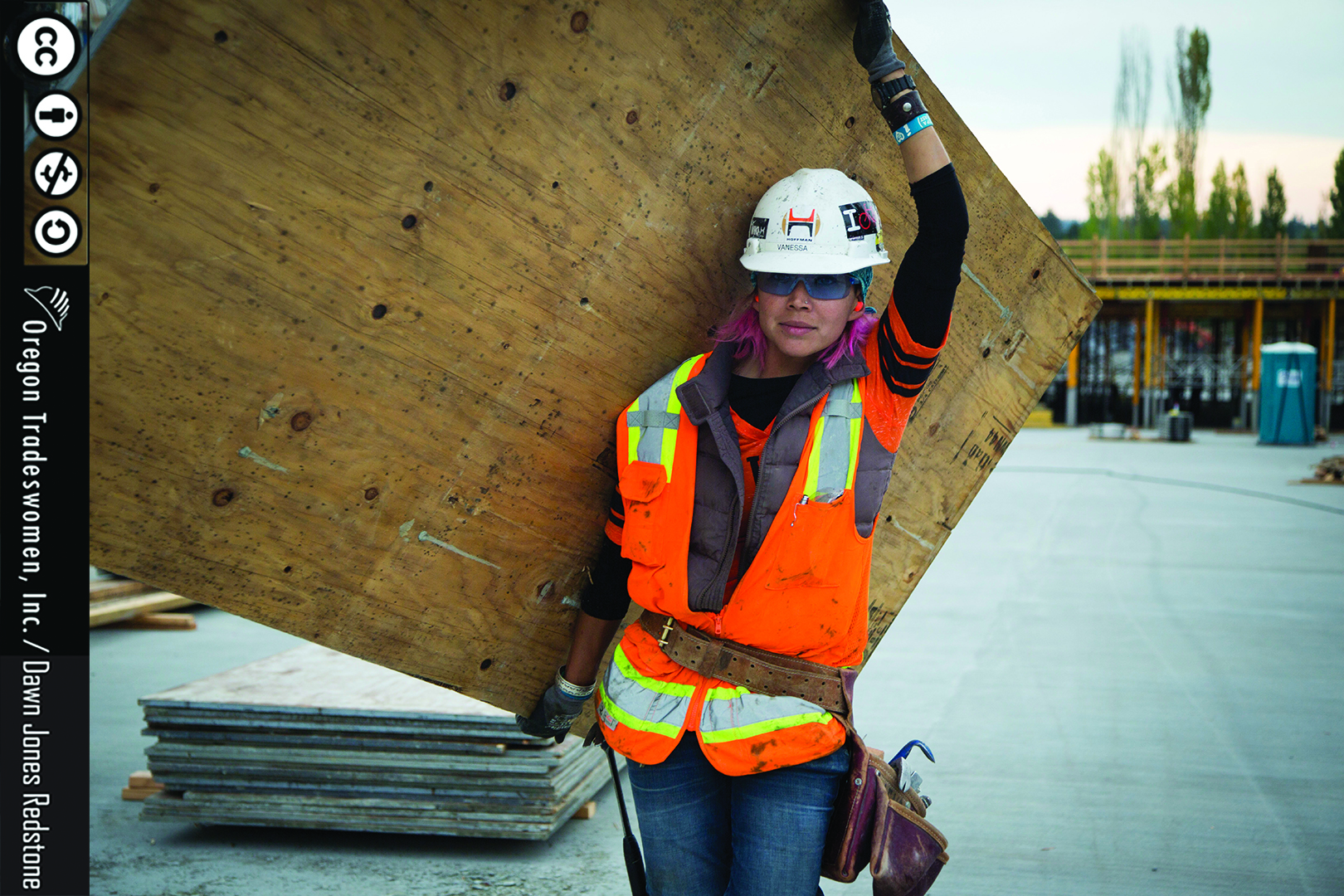
The traditional pathway to high-skilled blue-collar jobs is through registered apprenticeship, but those programs are not recruiting and training enough women. Nationally, as of FY2026, only 5.3% of apprentices in federally registered construction apprenticeship programs are women. Getting into the trades is only the beginning for the barriers women face: research has shown that women, and particularly women of color, face rampant discrimination and experience high rates of sexual harassment on the job — a major driver of attrition. A 2021 Institute for Women’s Policy Research survey of over 2,600 women in the construction trades found that more than a quarter (26.5%) reported being always or frequently harassed just for being a woman, and 23.6% reported always or frequently facing sexual harassment.
Partnering with unions is critical to closing these gaps, because unionized construction jobs come with stronger labor standards, better safety protections, and higher wages than their nonunion counterparts, and research shows unions are far more effective at recruiting, training, and retaining women and workers of color. According to a 2024 EPI analysis of registered apprenticeship data, women, Hispanic workers, and workers of color have higher participation and completion rates in union-affiliated apprenticeship programs than in nonunion programs. Women apprentices in union programs complete their training at a rate of 37.6%, compared to just 23.4% in nonunion programs. Any strategy to bring more women into infrastructure, clean energy, and manufacturing jobs must include deliberate partnership with unions and union-affiliated apprenticeship programs.
of construction trades
workers are women
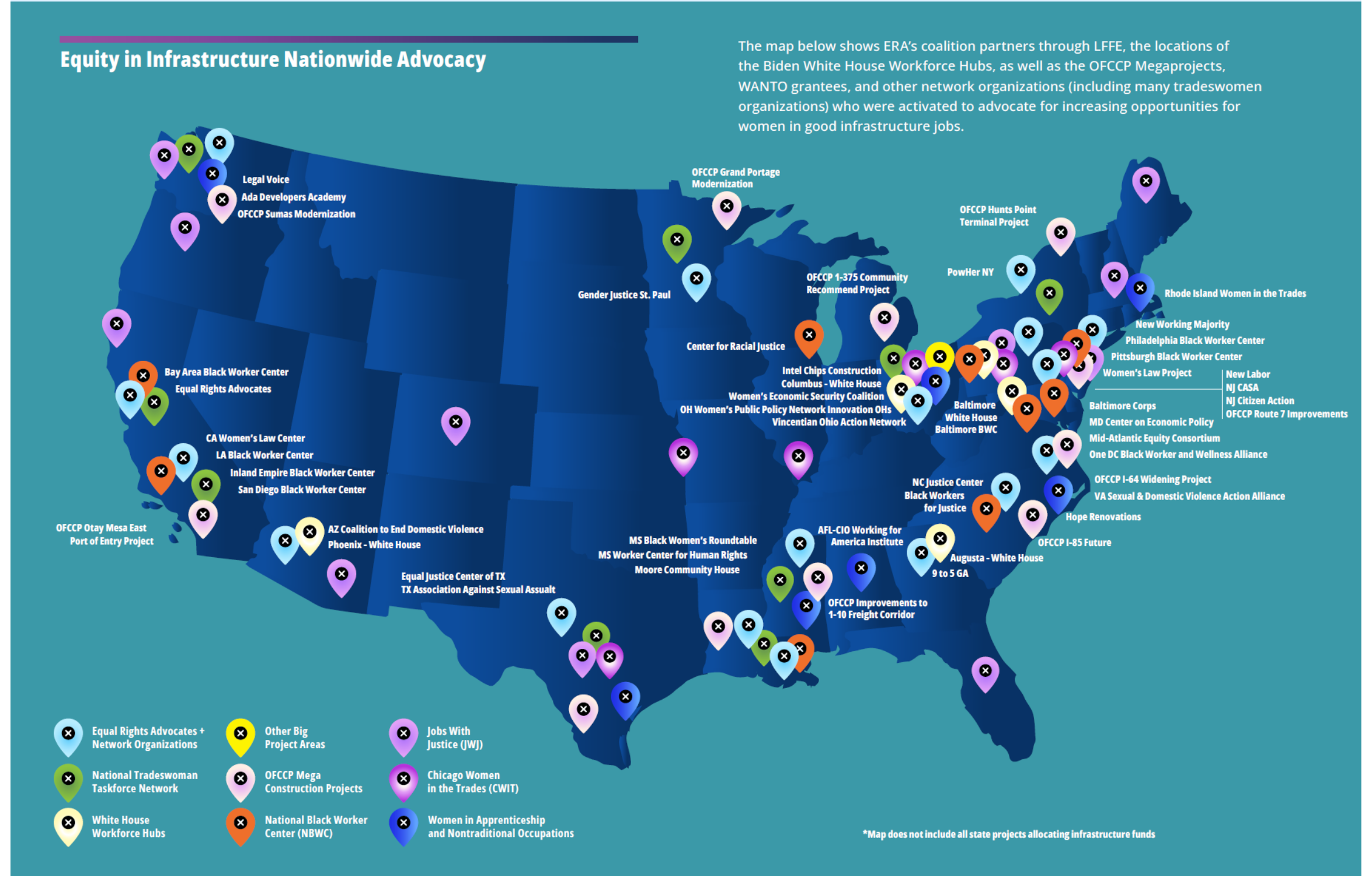
To capitalize on this potential, in 2022, the Center for Law and Social Policy (CLASP) and Chicago Women in Trades (CWIT) launched the Leveraging Federal Funds for Equity (LFFE) coalition to coordinate organizational plans, identify synergies and gaps, and collectively strategize on ways to be more aligned and impactful in the equitable distribution of federal infrastructure funds. LFFE was led by a dedicated steering committee, which included CLASP, CWIT, ERA, TWTF, Jobs to Move America (JMA), and Jobs with Justice (JWJ). The coalition worked to ensure that equity requirements were included in the federal agency funding instruments issued under the three infrastructure laws. As the funding began to flow down to state agencies into contractor bids, and was realized in actual jobs, the imperative shifted to ensuring that this equity language was adhered to on the ground and that it actually resulted in good jobs for women and especially women of color.
 As part of this effort, the LFFE steering committee sought to create the Equity in Infrastructure Gender Hub — a coordinated, multi-organizational initiative to bring an explicit gender lens to existing and developing advocacy and enforcement strategies in the states. The Gender Hub was designed to institutionalize collaboration between national, state, and local gender justice organizations; provide technical assistance and rapid-response support; collect and track workforce data; expand legal enforcement resources for survivors of workplace discrimination and sexual harassment; and coordinate directly with government agencies. The Gender Hub focused on four priority areas where the intersection of large-scale federal investment and acute gender inequity was greatest: tradeswomen in key construction markets; childcare access in semiconductor manufacturing communities; Black women entering EV battery and clean energy jobs in the South; and Latina women workers in the rapidly expanding construction and decarbonization sector in the Southwest.
Unfortunately, the federal landscape shifted dramatically with the change in federal administration in early 2025. The new administration’s severe cuts to infrastructure projects and equity-focused workforce organizations resulted in a major step backward in creating pathways to economic opportunity for underserved communities. The Office of Federal Contract Compliance Programs’ Megaprojects program—central to ERA’s strategy of positioning women and tradeswomen advocates on equal employment opportunity committees—has functionally ceased to exist under the new administration’s cuts to equity-focused workforce programs. The federal picture continues to be plagued with uncertainty and mixed signals: months after the cancellation of existing Women in Apprenticeship and Nontraditional Occupations (WANTO) grants in early 2025, the funding for the program was reissued in late 2025 and in fact has increased funds in 2026; apprenticeship expansion goals suggest workforce development support (though planned through funding employers rather than community based organizations, unions, or other workforce intermediaries, as has been effective previously); and simultaneously billions in previously approved infrastructure dollars continue flowing to projects (primarily in transportation construction) while billions of other dollars are cancelled (primarily on clean energy projects).
increase in the annual combined
wages of participants in a
pre-apprenticeship program
This level of federal uncertainty highlights the importance of strategic flexibility and the value of being able to adapt from a federal to state-based focus. When OFCCP’s Megaprojects program ended, organizations without strong state and local partnerships lost critical access points for workforce equity work. Future sustainable wins are likely to come from where equity requirements are embedded directly into state and local procurement policies rather than relying only on federal incentives—indicating a local commitment to the underlying objectives of expanding opportunity particularly for marginalized communities. Finally, and unsurprisingly, where ERA continues to see the most robust opportunities on the ground are where coalition infrastructure continues to survive, amplifying impact far beyond what an individual organization could achieve alone. These lessons directly shape ERA’s approach going forward. ERA continues to shift resources from federal advocacy to state and local partnership development, where infrastructure investments remain robust and equity commitment stays strong.

ERA’s focus on actionable policies also includes capturing the opportunities (and guarding against potential pitfalls) of the current boom of artificial intelligence. The supply chain of artificial intelligence was already part of ERA’s work to increase opportunities and improve working conditions for women in semiconductor chips manufacturing facilities, but that focus has necessarily broadened to include the massive explosion of efforts to build large-scale data centers in communities around the country. With billions of dollars on the line, it is more imperative than ever that we seek to maximize high-paying workforce opportunities for women while also ensuring that those same women are met with safe workplaces and their families and communities are not left behind.
At the national level, it was necessary to maintain a structured coalition of advocates who operated with a gender lens to facilitate technical assistance, strategic coordination, and other support for work on the ground.
During the Biden Harris Administration, the Leveraging Federal Funds for Equity (LFFE) coalition successfully engaged with leaders at the White House and the U.S. Departments of Labor, Commerce, Transportation, and Energy; this engagement allowed the coalition to identify largescale projects and distill agency priorities.
ERA led the LFFE steering committee’s work of mapping projects and organizations on the ground, including member affiliates, community-based organizations, labor unions, and tradeswomen-serving organizations. Many LFFE steering committee members had state or local affiliates that were already engaged in this work. For example, Jobs with Justice, Chicago Women in Trades, TWTF, and other members are already effectively working with state and local organizations on the ground on infrastructure and other issue areas. In 2024, LFFE used its mapping work to convene state focused infrastructure tables that included community-based organizations in key states, including Pennsylvania, Arizona, Colorado, California, Georgia, Tennessee, Louisiana, Texas, Ohio, and New York.
U.S. workers work
for an employer with
federal contracts
One anchor point for this network was the OFCCP’s Megaprojects program. OFCCP, prior to the new federal administration’s changes in 2025, served as the federal government’s chief civil rights enforcement agency for federal contractors; it was charged with enforcing federal laws that guarded against discrimination on the basis of sex, race, ability status, and veteran status. The Megaprojects program was renewed during the Biden Harris Administration and invested federal resources in a front-end approach to support contractor compliance with federal civil rights laws. For each project, OFCCP required the prime contractor to create an Equal Employment Opportunity (EEO) committee to ensure that hiring and retention pathways were open to workers from underserved communities. These EEO committees included representatives from the funding agency, a technical assistance expert from DOL’s Women’s Bureau, primes and sub-contractors, worker protection agencies, apprenticeship programs, one-stop job centers, community-based organizations, and community recruitment sources. The committees were meant to review data and identify issues to resolve, including barriers to employment and strategies for recruitment and retention. The committees were to also provide technical assistance to contractors in need of help with recruitment and retention of underrepresented workers.
Another key component of this national infrastructure was the Tradeswomen Building Infrastructure Initiative (TBII), a national project launched by Chicago Women in Trades (CWIT) Equity Resource Center and funded between 2022 and 2025 through a $1.3 million grant from the Department of Labor’s Women’s Bureau to increase the participation, retention, and advancement of women in construction careers tied to federally funded infrastructure projects. Rather than operating as a top-down effort, TBII worked by investing in local organizations that were already based in the work on the ground, providing technical assistance, funding, and coaching to help them deepen their recruitment reach in their own communities. TBII supported four state-based cohort partners: Heartland Women in Trades (HWIT) in Kansas City, Missouri; Central Ohio Women in the Trades (COWIT) in Columbus, Ohio; Texas Women in Trades (TEXWIT) in San Antonio, Texas; and West Virginia Women Work (WVWW) in Morgantown, West Virginia.
Each cohort used this support to build out strategies suited to its own region, from HWIT’s work on city ordinances and compliance tracking in Kansas City, to COWIT’s collaboration with the EEOC on workplace discrimination in Columbus, to TEXWIT’s partnership with the Texas Department of Transportation on childcare and jobsite culture, to WVWW’s launch of a new pre-apprenticeship program in Charleston that helped train over 100 women in 2024 and increased their combined wages by more than $624,000 annually. TBII also led targeted equity efforts with the Illinois Department of Transportation, the City of Philadelphia, and Women in Nontraditional Careers (WINC), a Philadelphia-based program preparing women for careers in construction and other high-wage, nontraditional fields. Across these partnerships, the initiative’s central lesson held true: equity work is most effective when it is delivered through sustained, flexible support to local organizations that already have the relationships and credibility to make change stick in their own communities.
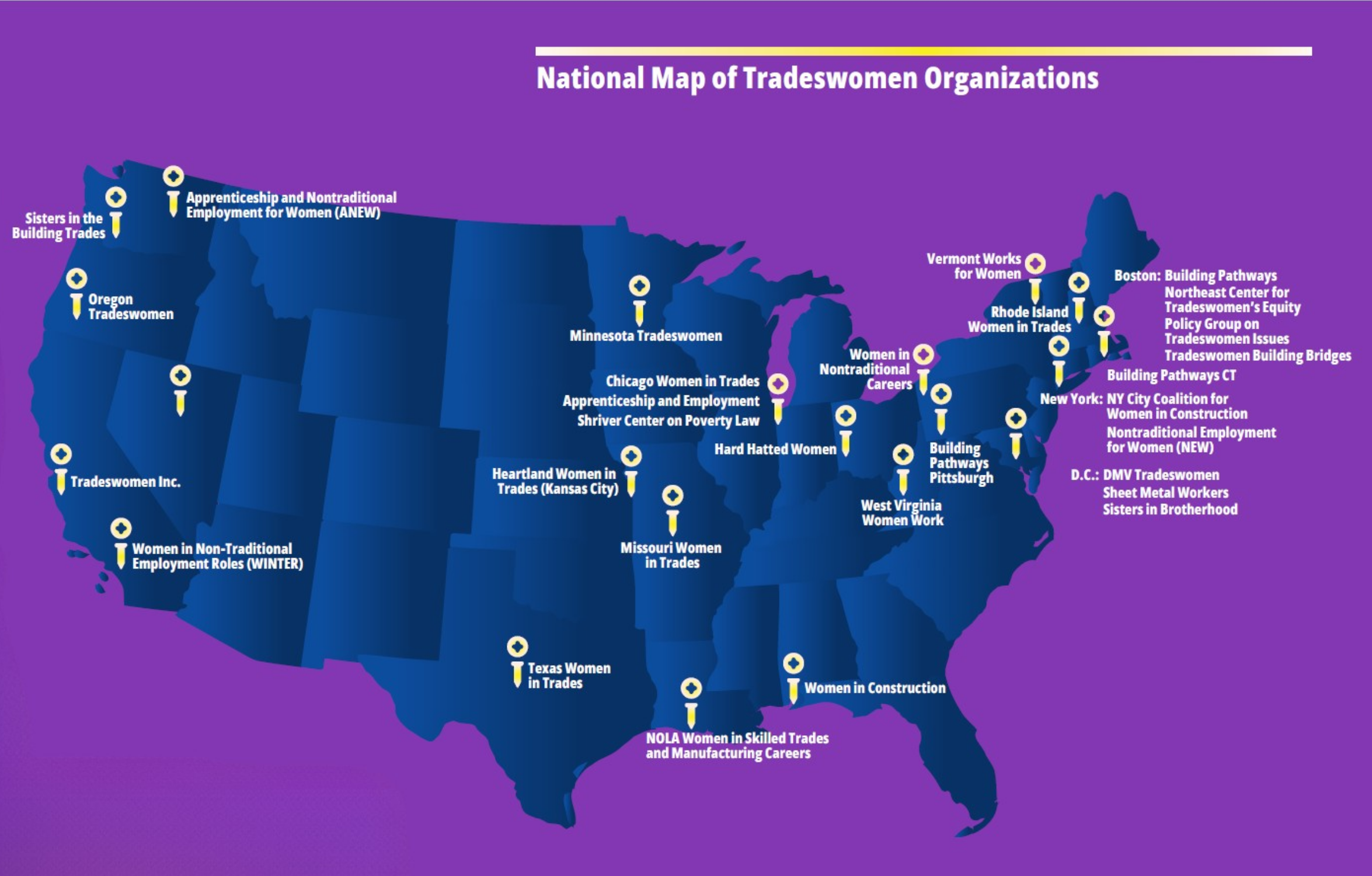
While the anchor point for much of this work has dropped out or stalled due to shifts in federal funding, maintaining these coalitions and networks remains essential for the work of pulling families out of poverty nationwide. The challenges remain steep however—the cuts in federal funding not only impacted civil rights infrastructure (like OFCCP Megaprojects and the Women’s Bureau’s technical assistance), but also critical operational and programming funding for many small nonprofit organizations. Many organizations have had to slash programs and furlough or lay off staff. Still, with key national partners, ERA has transformed the Leveraging Federal Funds for Equity coalition into the Coalition to Advance Workforce Equity (CAWE), expanding beyond federal funding questions to address workforce equity across all government funding levels in addition to concentrations of private investment.
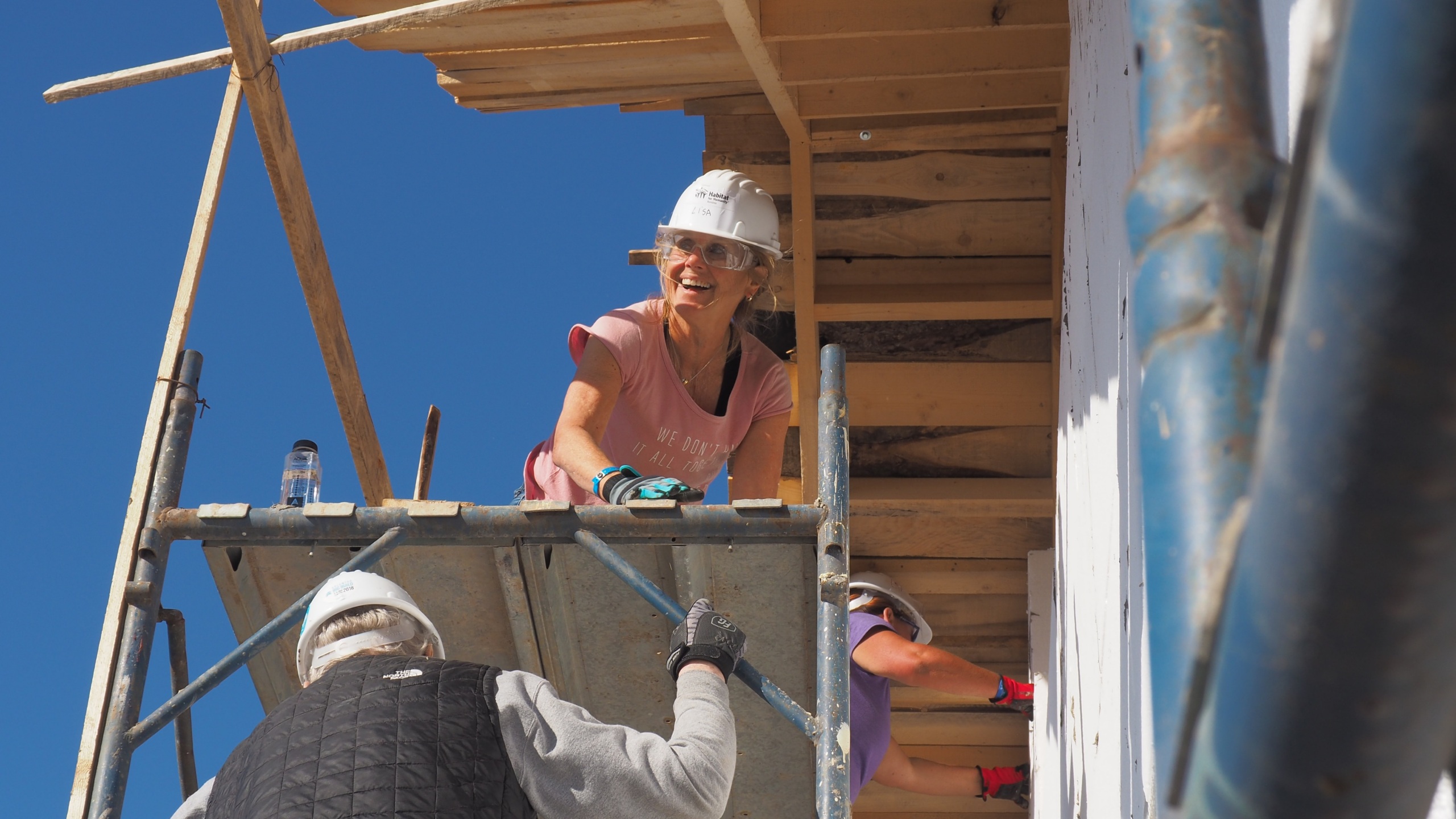
ERA began a partnership and provided resources to Texas Women Work, also known as Texas Women in Trades (TexWIT). TexWIT, supported by ERA, the Women’s Bureau, and other funders, played an active advocacy role on major Texas infrastructure projects subject to federal oversight. After OFCCP selected the organization to serve on the EEO Committee for the Brownsville-Gateway Modernization mega construction project, TexWIT began working directly with OFCCP on recruitment initiatives and used ERA’s financial support to send a group of women to OSHA construction training in advance of the project’s start, even as prime contractor selection for Brownsville slipped from an expected August 2024 date to the end of the year and beyond. The organization also successfully advocated for, and secured, a seat on the EEO Committee for the DART project in Dallas, participating in an initial introductory meeting and later working with OFCCP to broker an appropriate point of contact with project owner GSA regarding local union and contractor connections. To support this work on the ground, TexWIT built out a tracker of local Rio Grande Valley contractors, partner organizations, and training providers, alongside metrics on the existing construction workforce in the Brownsville area, and began holding regular information sessions paired with hands-on tool training. The sessions drew 13 registrants and 9 attendees in September and 10 registrants and 8 attendees in October, with growing interest among participants in welding, electrical, plumbing, carpentry, and general contracting. The organization also planned a paid OSHA training in November, aiming to grow attendance from 5 participants the prior year to 20, with funding set aside to cover trainees’ wages, childcare, transportation, food, and per-student training costs of approximately $555.
women attend
the Tradeswomen Build
Nations conference annually
In parallel, TexWIT began in mid 2024 convening a Monthly Mega Minds meeting that brought together tradeswomen-serving organizations, worker advocates, Women’s Bureau, and OFCCP staff from across the country to share information and provide technical assistance on issues such as government contracting and union hiring halls. Through these sessions, participants exchanged updates on projects in Texas, Colorado, New Mexico, and North Dakota, including persistent delays in prime contractor selection and EEO Committee formation; discussed broader policy issues, including the distinction between Community Benefit Agreements and Project Labor Agreements; and reflected on the growth and impact of larger convenings like Tradeswomen Build Nations, a conference that draws more than 5,000 tradeswomen annually. The meetings also became an important forum for discussing data collection practices needed to hold contractors accountable, including real-time workforce participation reporting by gender and race, with TexWIT maintaining a shared Megaprojects tracker and resource folder—containing links, flyers, data, and other materials—to document these deliverables and keep the broader network informed between meetings.
 In 2024, the U.S. Department of Energy’s Office of Energy Jobs launched the Community Workforce Readiness Accelerator for Major Projects (RAMP). RAMP was a two-year fellowship program in which 12 fellows from different regions and backgrounds were to “learn how to develop and implement strategic workforce partnerships in their communities.” As described by the Department of Energy at the time, “RAMP’s goal is to create and scale effective, inclusive workforce development strategies aimed at forging pathways for local workers, underrepresented populations, and disadvantaged communities (including justice involved people, youth, and women).”
The RAMP fellows began to do critical work of mapping and building coalitions of workforce stakeholders to create pipelines necessary for the massive workforce required for the large projects funded or otherwise supported by the Department of Energy, from electric vehicle battery manufacturing to offshore wind development. The RAMP program also assigned technical assistance providers to the Fellows to support their work. Through the Lawrence Berkeley National Laboratory, members of the TWTF supported the RAMP fellows in developing strategic plans for their geographies to effectively build pathways and high-road training partnerships for women and other underrepresented demographic groups, leading to good quality construction careers. In addition to this individual assistance, TWTF was to develop and provide participatory training on major topics to the RAMP Fellows and associated workforce coalitions.
Major training topics included:
Key concepts to successfully increase numbers of women and other underrepresented populations in construction
How to recruit and retain women and other underserved populations into registered apprenticeships and Apprenticeship Readiness Programs (ARPs)
Strategies for changing the culture on construction sites to increase retention
How to structure and engage in compliance meetings to meet and exceed hiring goals for women and other underserved populations in the construction of the identified DOE Infrastructure Projects
Actionable strategies for supporting women through their trades’ careers from apprenticeship-readiness through retirement, including the use of mentoring
Lessons learned from coalitions TWTF has helped form in various geographies, including developing additional funding sources to support participation by active underrepresented trades workers and other RAMP project purposes.
TWTF began their work as a Workforce Subcontractor in December 2024 and continued until late 2025, taking on substantial individual advising responsibilities for the RAMP fellows as they onboarded and began landscape analyses of their assigned regions.
But in late 2025, the Office of Energy Jobs reorganized the RAMP program. In its new iteration, at the new federal administration’s direction, the RAMP fellows were to implement the Department of Energy’s “Energy Workforce Strategy,” which focused on “drawing discouraged workers into the labor force.” The new focus was apparent from the various executive orders that the new federal administration had issued in its first year: not only eliminating all focus on efforts that could be considered “diversity, equity, and inclusion,” but also removing funding and support for any clean energy projects and shifting resources instead to fossil fuels, nuclear power, and critical mineral extraction.
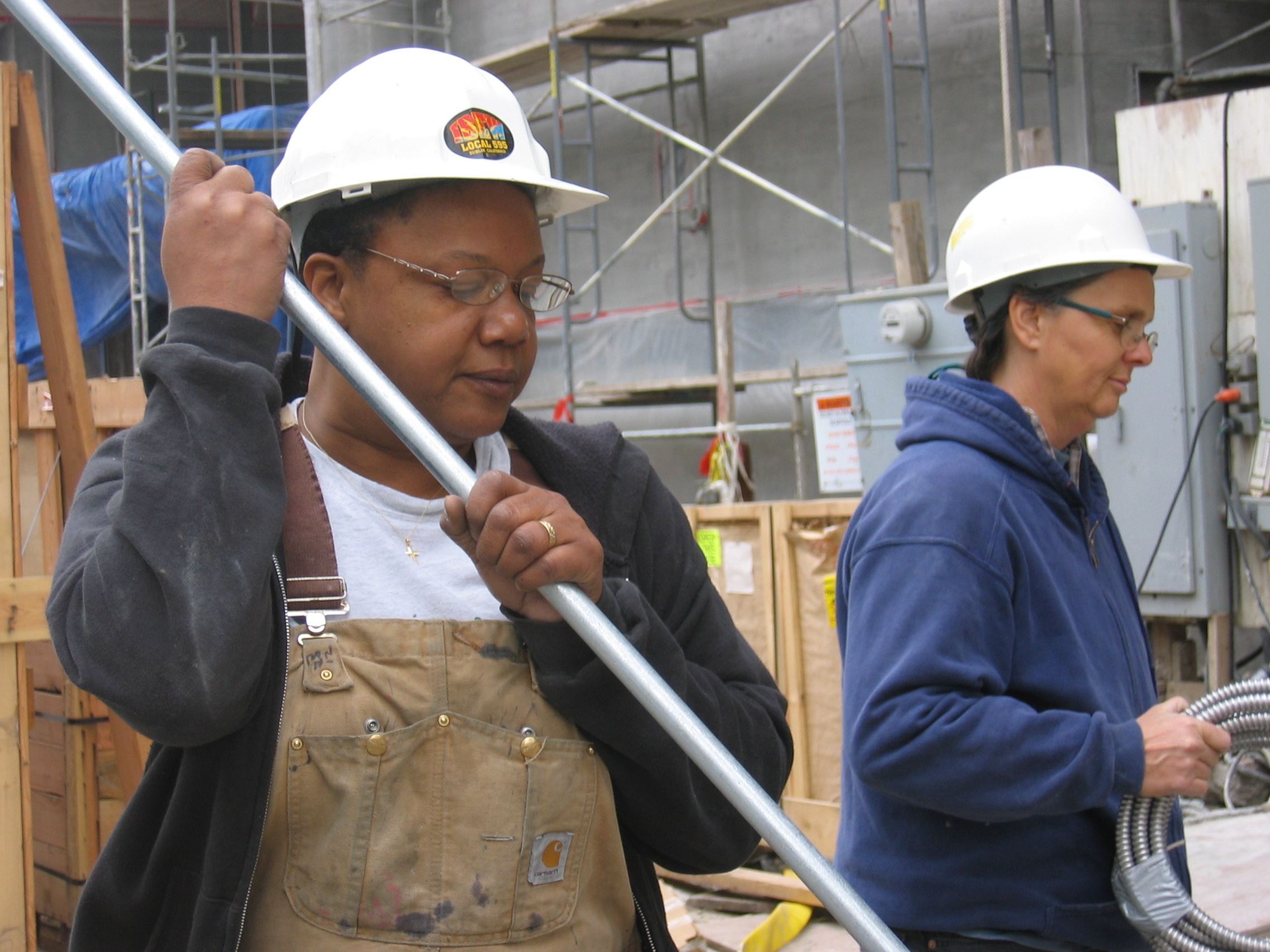
Under these new terms, most of the fellows’ original work was discontinued, along with the Taskforce’s involvement in the project. This came just as fellows were translating months of landscape analysis and relationship-building into functioning workforce partnerships, and it put at risk some of the early pipelines the fellows had begun building for women and other underrepresented workers into registered apprenticeships.
Even so, RAMP demonstrated real proof of concept in the time it had: some fellows built coalitions strong enough that local partners have chosen to carry that work forward on their own. In Texas, for example, the fellow was instrumental in creating several successful coalitions that have since been adopted by entities now sustaining that work. These outcomes suggest that RAMP’s core model, pairing dedicated regional fellows with expert technical assistance, is one worth restoring and scaling, so that more regions can build on the momentum the program showed was possible.
Also in 2024, ERA partnered with and provided resources to YWCA Columbus. YWCA Columbus was engaged with the Biden Administration’s Workforce Hub based in Columbus, Ohio, designed around ensuring students and workers had equitable access to good-paying jobs created by President Biden’s Investing in America agenda, including substantial semiconductor investments in the area. ERA used funds to support YWCA’s work advocating for the provision of quality and accessible childcare for construction and manufacturing workers at the Intel plant in Ohio as well as the inclusion of the construction trades as career pathways for women.
Gift from Intel to
support childcare in the
Columbus community
YWCA Columbus had the potential to serve as a uniquely positioned advocate and partner in the development of the Intel plant in New Albany, with the credibility and relationships needed to ensure women could access and remain in good jobs throughout both construction and long-term manufacturing operations. As a longstanding champion for women and girls, YWCA Columbus brought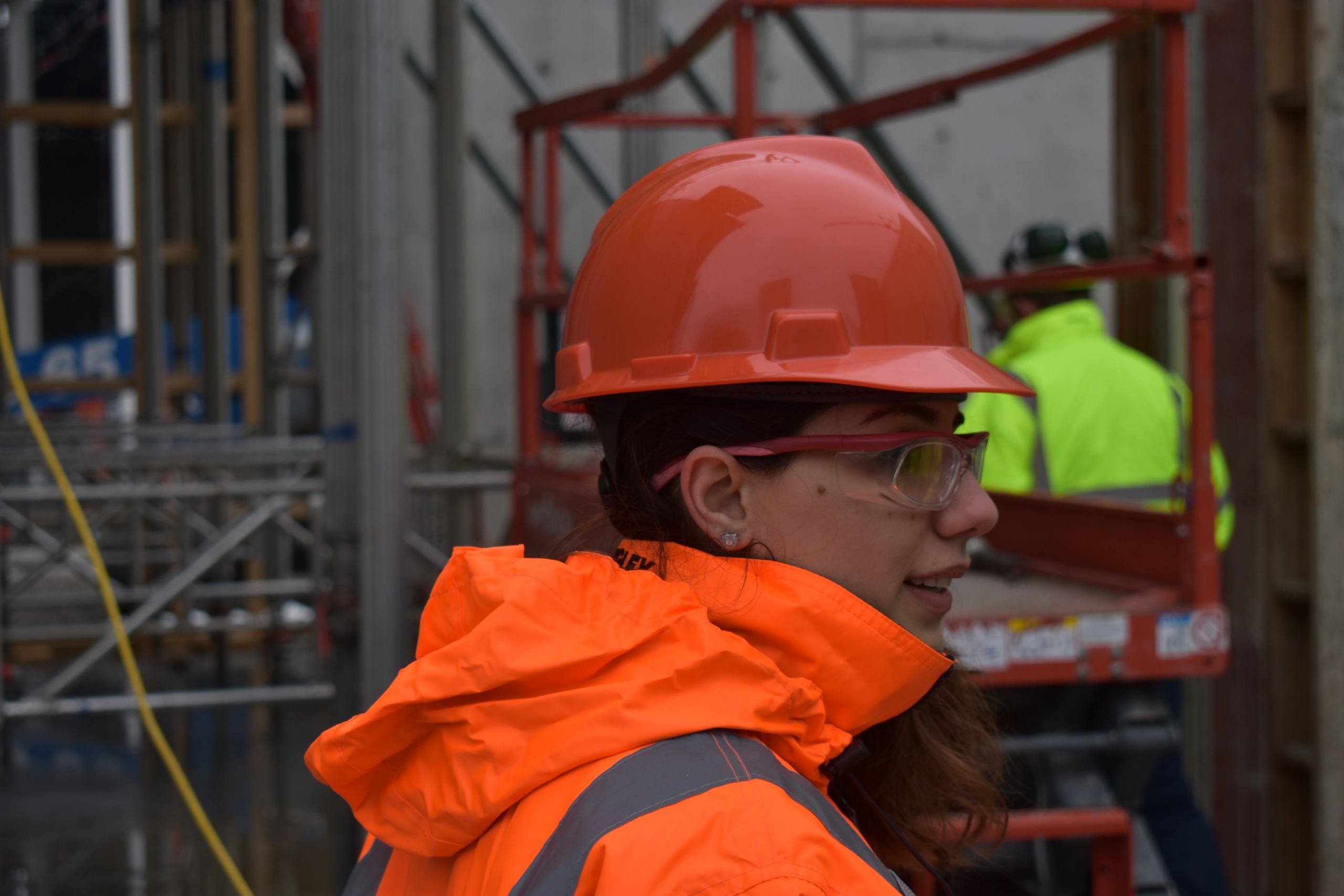 political savvy and the ability to communicate across community, education, and corporate stakeholders. YWCA Columbus’s deep expertise in childcare would have allowed it to guide Intel and area colleges on what affordable, accessible, reliable, and high-quality childcare should look like, while its standing as a trusted service provider for women and families would have positioned it to advocate for pathways for women into construction trades and supports in the workforce once they got there.
Beyond advocacy, YWCA Columbus offers practical, on-the-ground value as a childcare provider and connector to employment. Its experience as a childcare operator would have made it well suited to help design new childcare programs near the Intel site, including options responsive to the nontraditional hours required by construction and facility workers, and to advocate for direct childcare investment from Intel, building on the company’s earlier $2.8 million gift to Columbus State Community College. Through its housing programs, a new pilot with local building trades, and ties to organizations like Central Ohio Women in the Trades and Columbus Building Futures, YWCA Columbus would also have served as a critical pipeline connecting underemployed women and girls to apprenticeships, training, and ultimately the community college pathway into semiconductor manufacturing careers, jobs estimated to pay around $135,000 a year and capable of transforming economic outcomes for women and families across the region.
Estimated annual
salary for jobs in
semiconductor
manufacturing
Prior to the end of the Biden Administration, YWCA had been able to connect with leadership at Columbus State Community College (the White House designated lead for the hub), Intel’s lead on childcare, and the construction prime, Bechtel. YWCA had also engaged and met with the head of the statewide building and construction trades union and participated in a Women in Construction Roundtable, which was hosted by Central Ohio Women in the Trades with funding support from DOL’s Tradeswomen Building Infrastructure grant program and included Intel, Bechtel, and representatives from OFCCP, the Women’s Bureau, the Columbus Mayor’s office, and Ohio Department of Transportation, among many others.
In 2025, ERA partnered with Fresh Start Women’s Foundation, a Phoenix-based nonprofit that provides comprehensive wraparound services to women working toward economic independence. Fresh Start supports women across five core areas: family stability, health and well-being, financial management, education and training, and careers. This holistic model helps women address barriers to economic security, build confidence, and prepare for long-term career success.
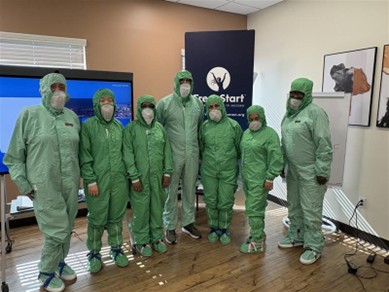
As part of its workforce development strategy, Fresh Start has expanded access to nontraditional career pathways for women, including by providing job training for semiconductor manufacturing, advanced manufacturing, and construction-related trades. Through cohort-based training models, women participate in career preparation while receiving Fresh Start’s wraparound supports (described below), coaching, follow-up, and peer support. This model was initially designed and launched with WANTO funds from the Department of Labor; Fresh Start was a two-time grantee (in 2022 and 2024) whose funding was cancelled in early 2025 by the DOL. With ERA’s support, and by braiding that funding with other available resources, Fresh Start supported women in high-demand workforce pathways throughout the fiscal year. This included 21 women who completed the semiconductor training program through BaltuTech and 42 women who participated in construction and construction safety programming.
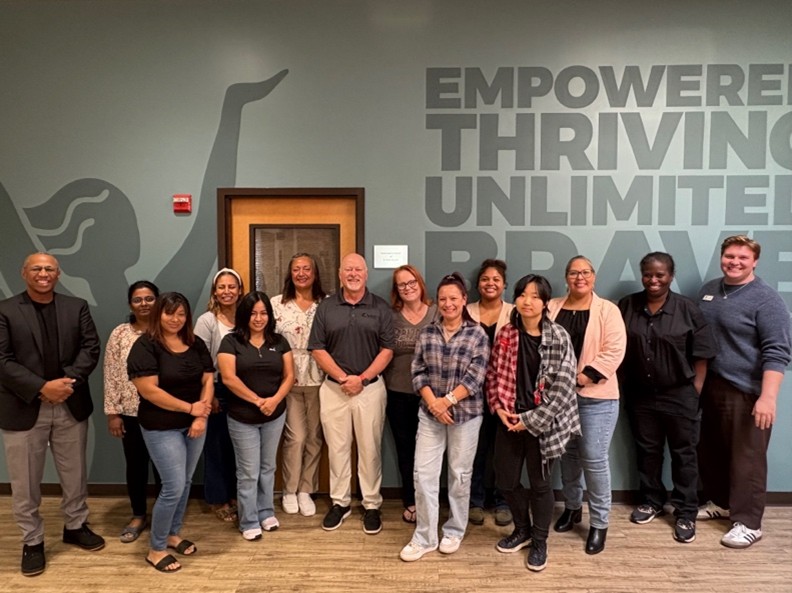
Fresh Start’s semiconductor pathway program connects women to training opportunities aligned with Arizona’s growing semiconductor industry. Participants receive support as they prepare to gain industry-recognized skills, credentials, and interviews with local employers. The cohort model is especially important because many Fresh Start clients are single mothers, survivors of domestic violence, or women earning low incomes who are working to build greater financial stability.
Fresh Start also offers construction safety training that prepares participants for entry-level opportunities in the construction industry. This includes foundational career readiness, exposure to building trades pathways, and certifications such as OSHA10 and Flagger training.
Katrina’s Story
Katrina was raising three children on her own by the time she was 23, and struggled to find a steady, fulfilling career. When her youngest daughter Aliyah graduated high school, Katrina noticed her struggled for many years to find direction, too. So Katrina decided to take a chance, enrolling them both in a free, 6-week semiconductor manufacturing technician training course at Fresh Start.
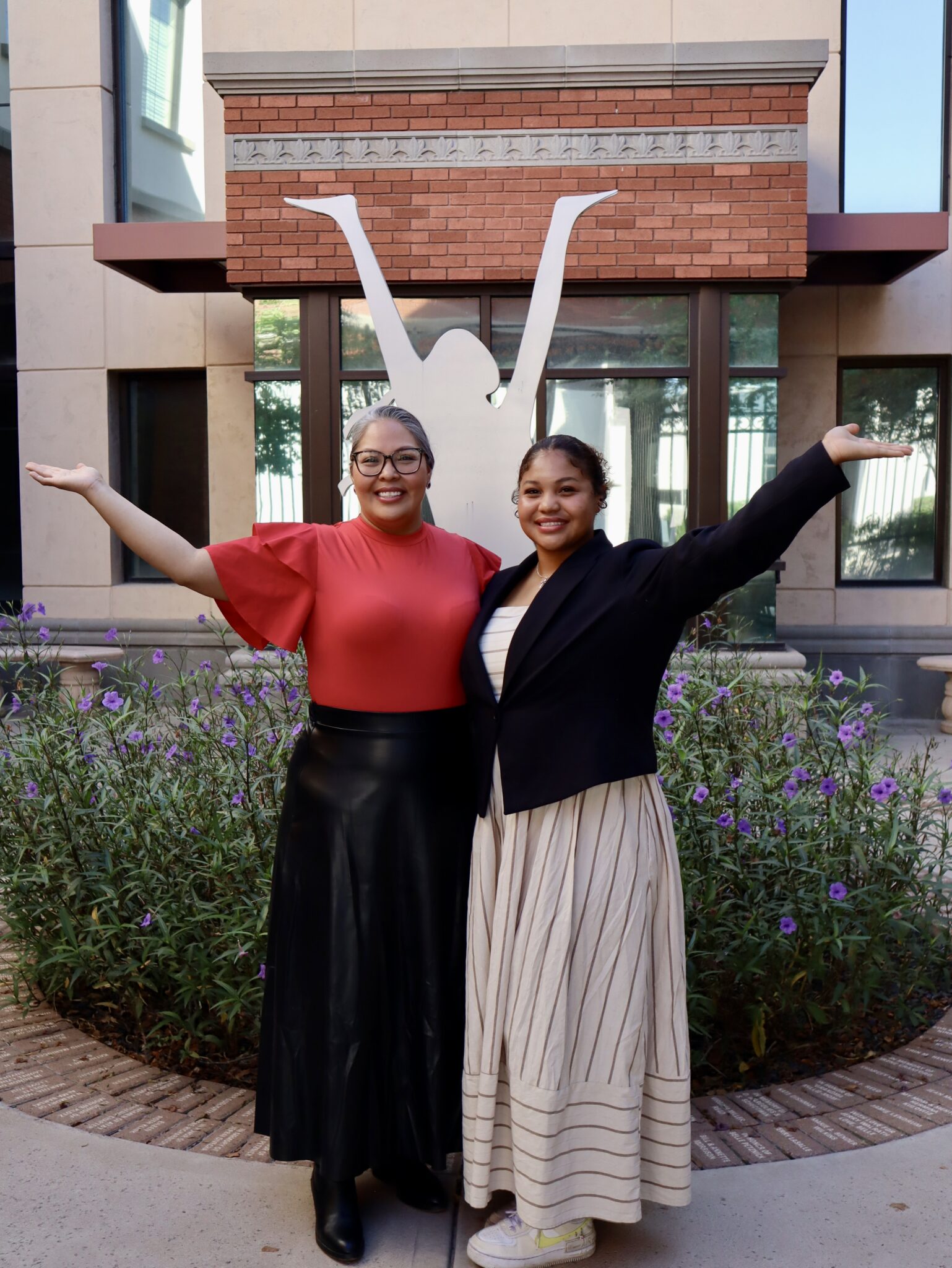
They became the first mother-daughter duo to go through the program together. Shortly after completing the program, Aliyah was hired as a Semiconductor Production Associate, and Katrina was promoted by her new employer. The program even inspired Katrina to go back to school for her associate’s degree.
Tina’s Story
Fresh Start graduate Tina, a mother of five, joined the program after experiencing homelessness despite working hard throughout her life.
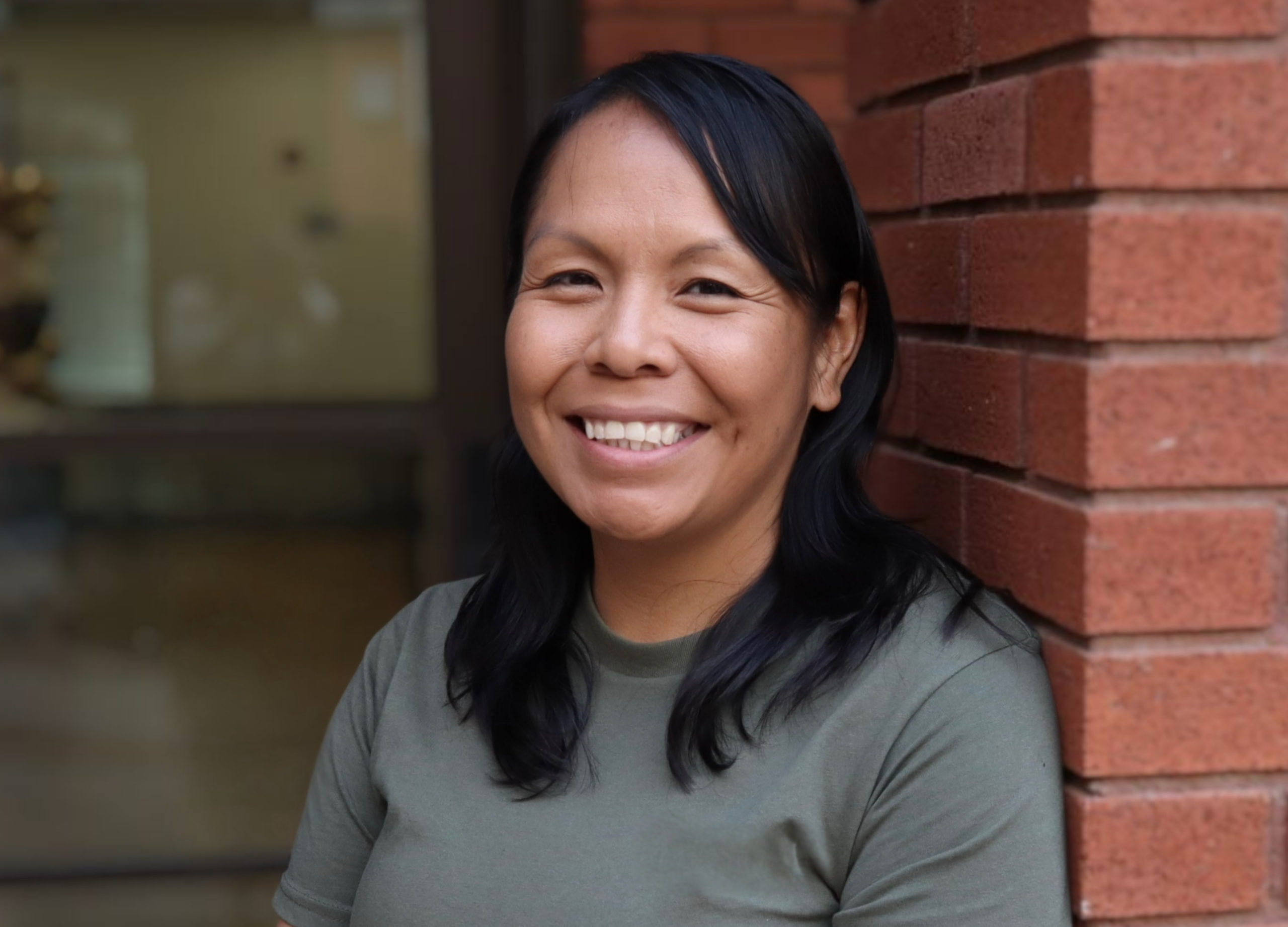
After participating in the Construction Safety training course, Tina became the first woman in her cohort to be hired as a Flagger. Fresh Start also provided short-term support to help her sign a lease until she received her first paycheck. Tina worked hard, and after just 90 days on the job, she was promoted and earned an additional traffic certification. She continues to build her career in construction and move closer to her long-term financial goals.
Maribel’s Story
After spending more than 30 years building a career in finance, Maribel experienced a sudden lay off that left her asking what she truly wanted to do next. She came across a flyer at her local unemployment office for Fresh Start’s semiconductor manufacturing course, signing up when she realized it was not only free, but specifically for women.

Maribel started the semiconductor technician program in October 2025. The material was dense and technical—unlike anything she’d experienced in finance—but Fresh Start supported her in challenging moments. Soon after completing the program, Maribel achieved her goal of breaking into the industry and was hired as a Semiconductor Production Associate in Phoenix.
In 2026, ERA partnered with the Houston Gulf Coast Building and Construction Trades Council (HGCBCTC). HGCBCTC runs an apprenticeship readiness program, or a pre-apprenticeship program that utilizes the Multi-Craft Core Curriculum (MC3), through which it does broad recruitment for an introduction to the construction trades, and uses its relationships with the local Department of Labor Registered Apprenticeship Programs to secure apprenticeship and employment opportunities for its graduates. The program itself is a 3-week course designed to prepare graduates for an apprenticeship in the building and construction trades. The course is free for the students.
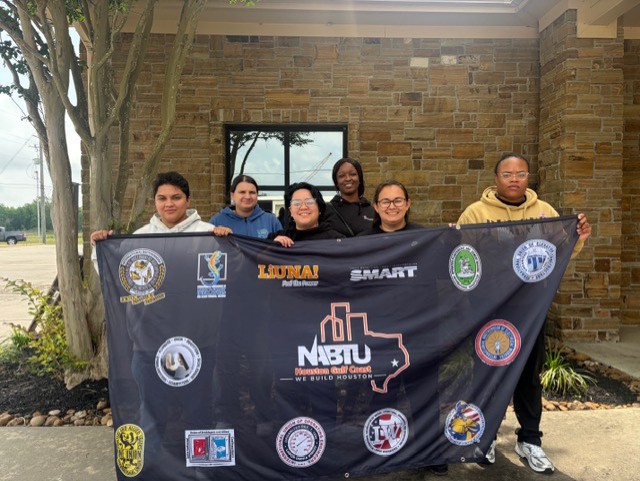
HGCBCTC connects their participants with supportive services, including support for transportation, childcare, and other local workforce assistance with funds for tools and work boots. Past cohorts have included between 18-27% women, with a high placement rate in apprenticeships and construction employment. HGCBCTC is using funds from ERA to conduct outreach, recruitment, and apprenticeship readiness training for women in the Houston area. The funds’ impact will be amplified with a newly formed Tradeswomen Committee in anticipation of the next Tradeswomen Build Nations conference (scheduled for Houston, Texas, in October 2026).
of HGCBCTC’s
apprenticeship program
participants are women
HGCBCTC has run two cohorts of their apprenticeship program in 2026, supported by subgrants from ERA. Six women participated in each cohort. Following graduation, nine women have applied to apprenticeship programs and are in the process of getting accepted with the Pipefitters Local 211, Sheetmetal Local 54, Painters Union District Council 10, IBEW JATC 716, Operators Engineers Local 450, and Elevator Constructors Local 31. Two of the women have already secured work with the Painters Union Apprenticeship Program.
To advance its commitment to providing state and local advocates with technical assistance on effective state-based advocacy, ERA worked directly with organizations in California and Nevada.
In California, ERA is working alongside tradeswomen advocates on legislation to codify an impactful state program to fund training and wraparound services to support women in construction (AB 1980) and to collect more data to understand the current state of women in construction and the barriers they experience in staying in the construction trades (AB 2550).
ERA has met with state legislators’ staff to ensure that these bills are a priority and to provide support as the state legislators are discussing the legislation in session. As of this writing, both of these bills have unanimously passed through the California State Assembly and are currently moving through the California State Senate.
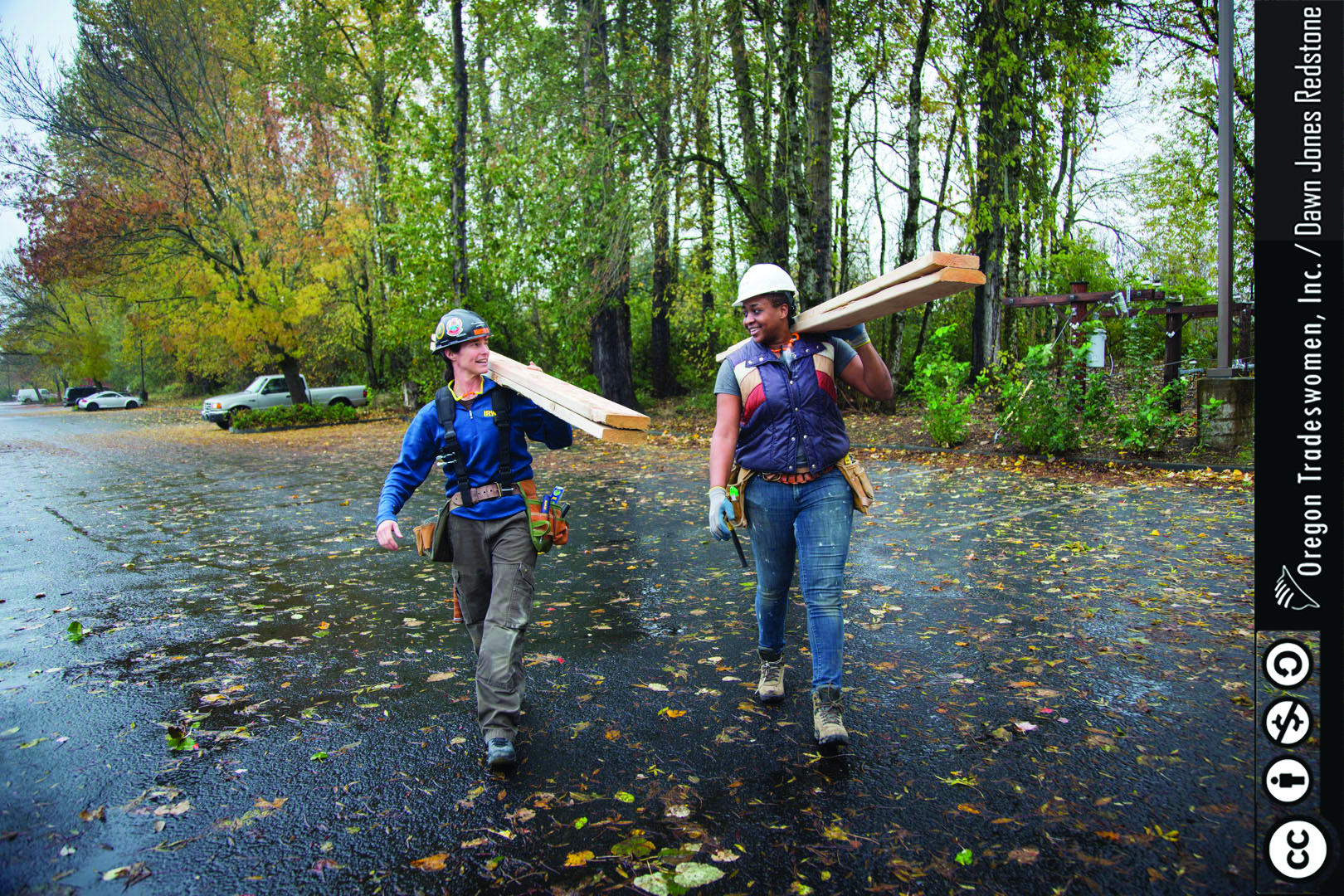
In Nevada, ERA is supporting Nevada Women in Trades in their ongoing fight for legislation that would help tradeswomen. In 2025, ERA assisted in advocacy for, legislation that would have helped identify gaps in access for women, veterans, and other underrepresented groups to high-wage careers in the construction trades in Nevada (AB 222). ERA provided grassroots communications support for this effort, including creating video and social media content to elevate tradeswomen’s voices and stories. ERA also helped to mobilize tradeswomen and other supporters around the country to urge legislators to advance the bill from committee to a work session, a necessary step towards a full vote in the Assembly. While the 2025 effort was ultimately not successful, ERA and Nevada Women in Trades are already preparing to support a similar bill in the 2027 legislative session.
One important source of technical assistance and resources for this work had previously come through federal grant programs designed to protect women workers from harassment and violence on the job. The FARE grant program was a U.S. Department of Labor Women’s Bureau initiative that funded community-based organizations, unions, and other nonprofits with established ties to underserved and marginalized women workers so they could build awareness of, and prevent and respond to, gender-based violence and harassment in the workplace, providing outreach, connecting workers to services, and empowering women through information. ERA and TWTF’s program included plans to develop and disseminate a range of educational materials on workplace gender-based violence and harassment (GBVH), including Know Your Rights resources translated into multiple languages, as well as comprehensive training materials. Ongoing outreach would have connected women workers from historically marginalized or underserved communities to legal information, advice, counsel, and referrals. Additionally, ERA was to provide continued technical assistance and support to peer educators to sustain workplace GBVH training efforts in California. This work was abruptly halted when the new administration cancelled all of the FARE grant recipients’ funding in 2025.
Despite the cancellation of the grant, ERA has persisted in sharing Know Your Rights materials, conducting trainings, and accepting inquiries for legal services for tradeswomen. For example, ERA provides broad Know Your Rights trainings to tradeswomen from around the country at TWTF’s annual Institute.
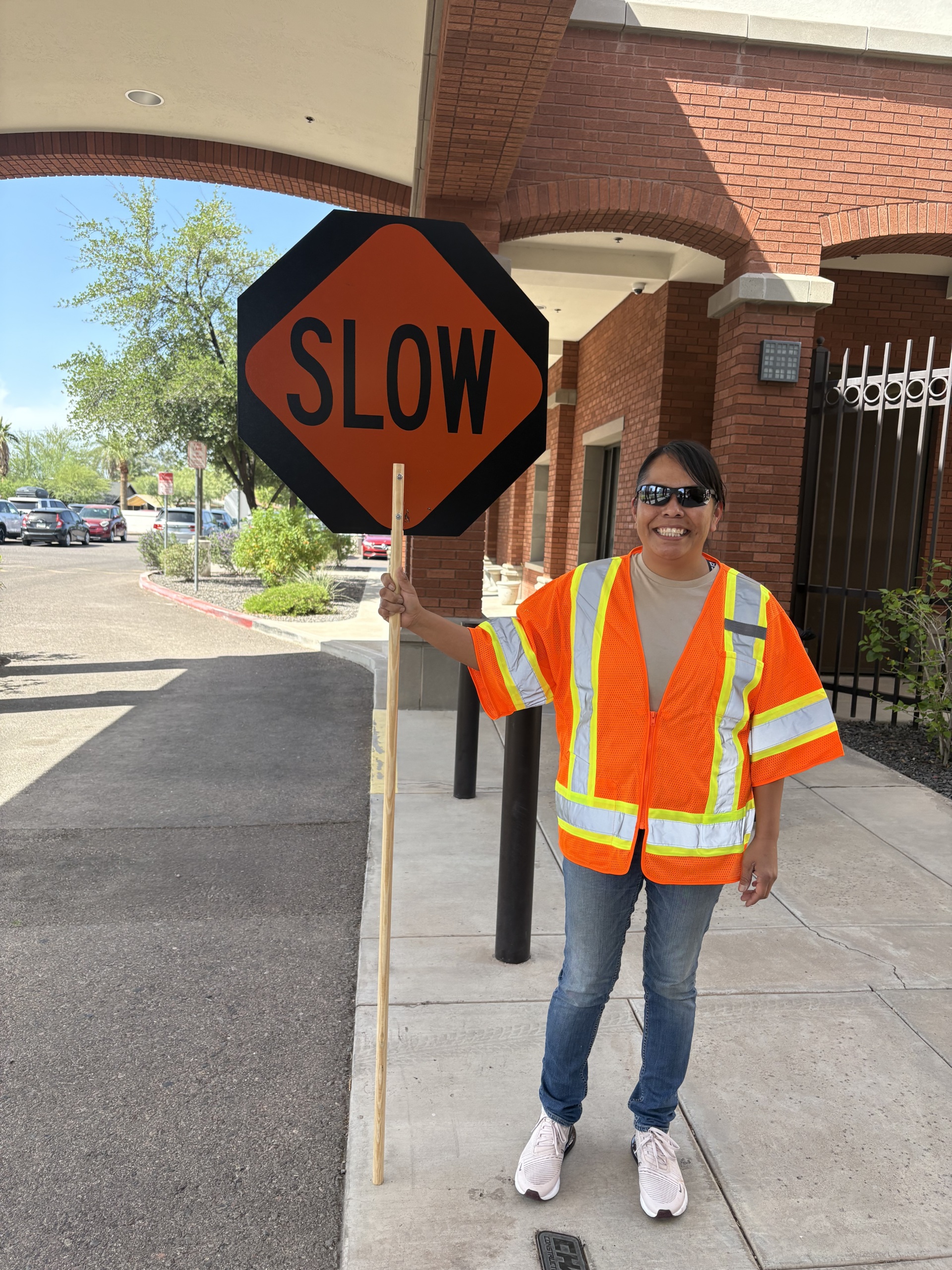
ERA has also partnered with the Construction Trades Workforce Initiative, which runs an apprenticeship readiness program in California and the Baltimore / DC area, to provide equal employment opportunity training for its 2026 training cohorts in Baltimore and DC. This presentation covers the key federal and state laws that protect employees from discrimination, including Title VII, the Pregnant Workers Fairness Act, the Equal Pay Act, and DC and Maryland state laws. The workshop distinguishes between unlawful harassment (hostile work environment and quid pro quo) and merely inappropriate behavior, using activities and scenarios to help participants recognize the difference. It also explains retaliation protections, filing deadlines with agencies like the EEOC, and practical steps employees can take if they experience harassment. The presentation closes with bystander intervention strategies and contact information for workers seeking legal support.
Trainings like these are critical to inform workers of their rights and set the tone for inclusive workplaces at the outset of their entry into the construction workforce. TradesFutures’ standardized Multi-Craft Core Curriculum (MC3), used in hundreds of apprenticeship readiness programs around the country, has a section devoted to Maintaining a Respectful Workplace that local programs can augment by partnering with an organization experienced in dealing with discrimination and harassment. For instance, ANEW, a Seattle-based organization working to diversify the construction trades by increasing access and opportunity for women and people of color, runs a pre-apprenticeship program and, separately, the RISE Up program. RISE Up is a combined campaign and training system that relies not just on training employees but engaging at every level of a construction worksite (owners, contractors, supervisors, and workers) to move beyond just the rules and regulations to ensure a culture of respect, inclusion, safety, and equity.
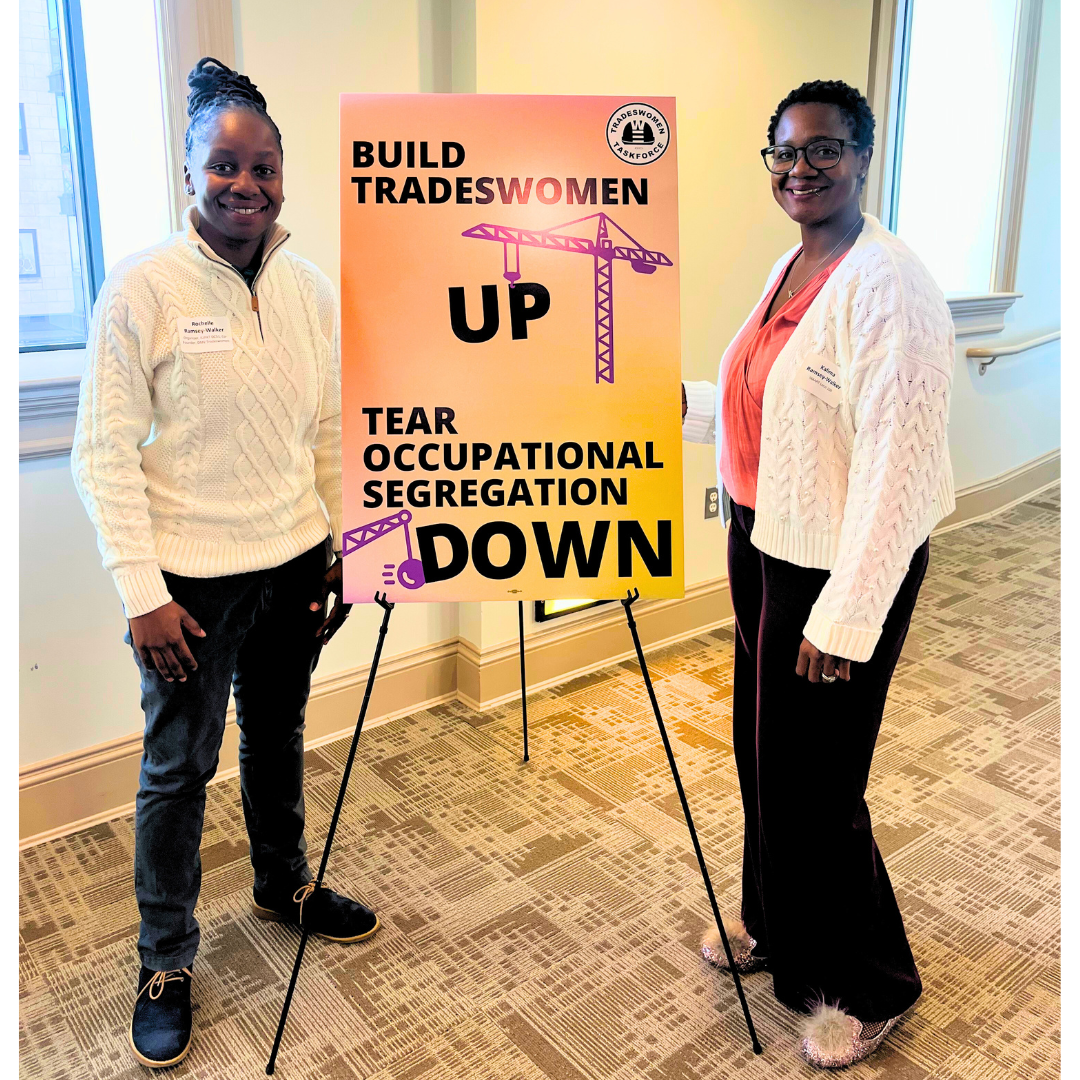
But these programs are not in place everywhere. Training that enables a respectful worksite remains inconsistent across the construction industry, with many training programs and worksites offering only baseline legal compliance content rather than the sustained, culturally competent, and industry-specific instruction that programs like ANEW’s RISE Up demonstrate is possible. Closing this gap will require greater investment in legal resources and partnerships that can help workers not only understand their rights and recognize unlawful conduct, but also access legal support when violations of their rights occur. ERA and the TWTF are working, through committee meetings and the annual Institute, to spread knowledge and encourage adoption of robust Respectful Workplace training models.
In 2025, ERA surveyed coalition partners and advocates to build a resource of contract terms that building trades unions, community organizations, or other stakeholders can draw from when crafting community benefits agreements for infrastructure and construction projects. It covers a broad range of provisions across several key areas: setting numeric hiring goals for women and people of color at both apprentice and journey levels; prioritizing dispatch of workers from economically disadvantaged areas or those facing significant barriers to employment; and requiring contractors to develop childcare plans that are affordable, accessible, and reliable for construction workers. The resource also includes extensive anti-harassment provisions, requiring contractors to implement clear workplace policies, multi-channel complaint systems, regular training for all workers and supervisors, and anonymous reporting hotlines. Finally, it calls for the formation of an Access and Opportunity Committee — made up of community organizations, unions, contractors, and project owners — to monitor compliance with diversity and equity goals on an ongoing basis.
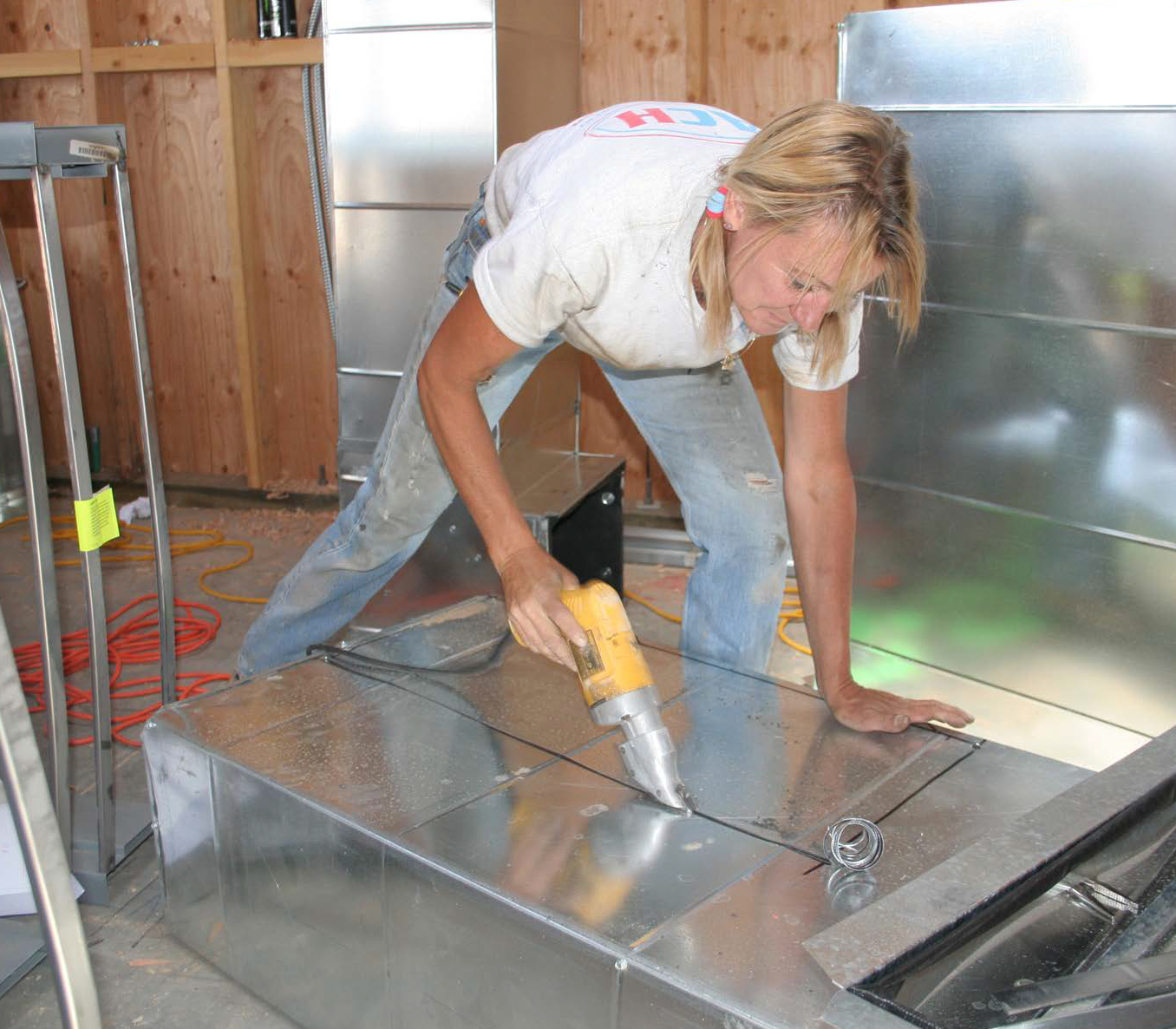 ERA conducted research to identify bad actors and repeat offenders among contractors who were associated with a project slated to receive major investments from public or private infrastructure funding. ERA also searched federal labor enforcement databases — specifically the Department of Labor’s Wage and Hour (WHD) data and OFCCP (Office of Federal Contract Compliance Programs) compliance sheets — to identify violations. ERA filtered DOL data for incidents from January 1, 2020, onward and cross-referenced multiple OFCCP data files on complaint investigations, compliance evaluations, FOIA closed cases, and notices (obtained through ERA’s FOIA requests as detailed below) to compile a comprehensive violation record for each contractor.
ERA recorded the results of searches conducted as of June 30, 2025, covering prime and subcontractors on construction projects (such as the Hudson Tunnel, Amtrak Baltimore, and various highway projects) and EV battery facility projects (primarily the Blue Oval City site in Tennessee).
After the change in Administration, ERA moved quickly to request FOIA records from the Departments of Labor, Transportation, Commerce, and Energy about their infrastructure projects, including commitments around workforce equity. The Department of Commerce did provide documents, including initial agreements with several semiconductor manufacturing companies.
While the agreements were in most instances superseded by later agreements with the new federal administration, ERA shared these documents with other coalition partners (including Jobs to Move America and CHIPS Communities United), who have used the information in their campaigns for community benefits agreements in several states.
The Department of Labor was responsive in providing records from the national office and some of the Megaprojects regarding their EEO committee meetings and who was involved, but given the early stages for most of these projects, the Department did not provide material that was useful. ERA was able to collect information about contractors with problematic compliance and complaints investigation records through this process to share with coalition partners.
ERA continues to deepen its state and local relationships through a new partnership with TradesFutures. TradesFutures is a national non-profit established by North America’s Building Trades Unions (NABTU) and industry partners in order to expand access to union apprenticeships, largely through a network of over 200 apprenticeship readiness programs (ARPs). TradesFutures’ main goals in working with ARPs that use the MC3 curriculum to expand the overall pool of qualified apprenticeship candidates from all walks of life across all trades and improve apprentice retention by giving candidates a stronger foundational understanding of both the construction industry and the role craft unions play within it.
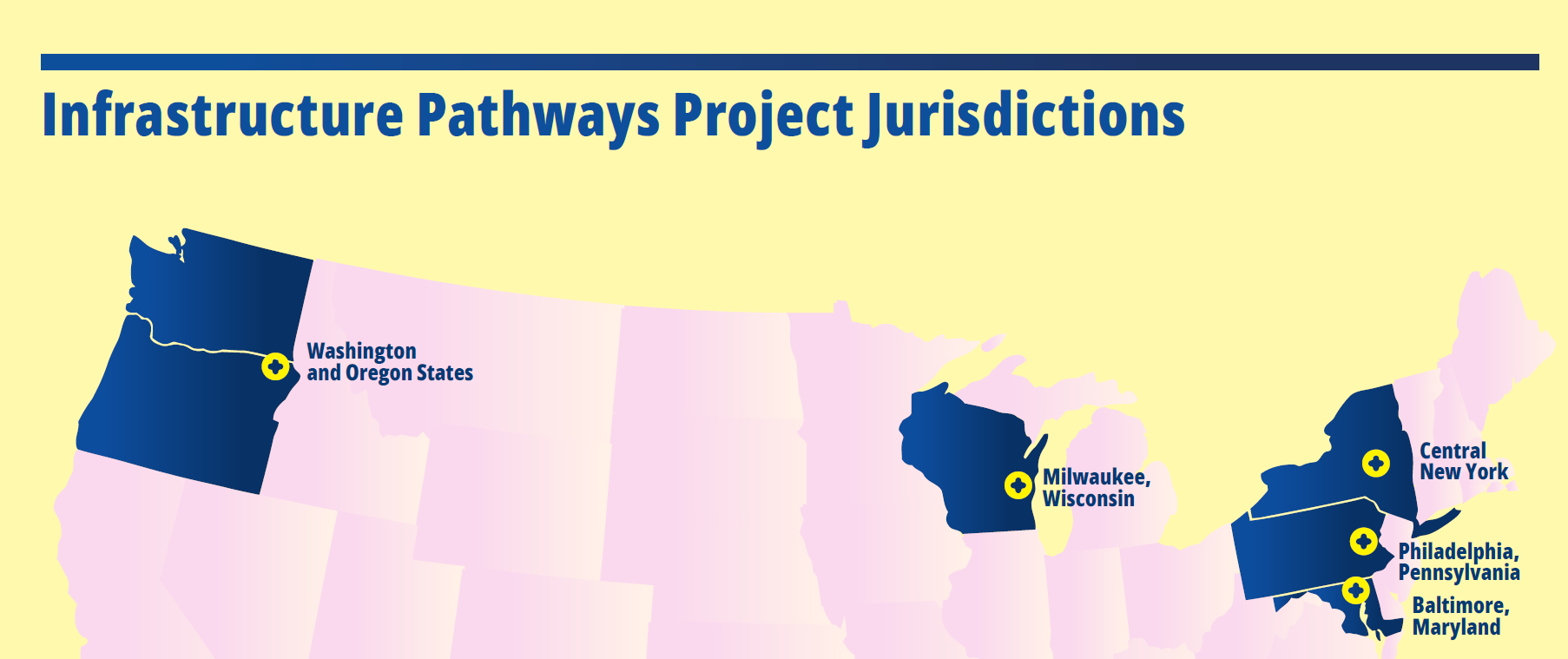
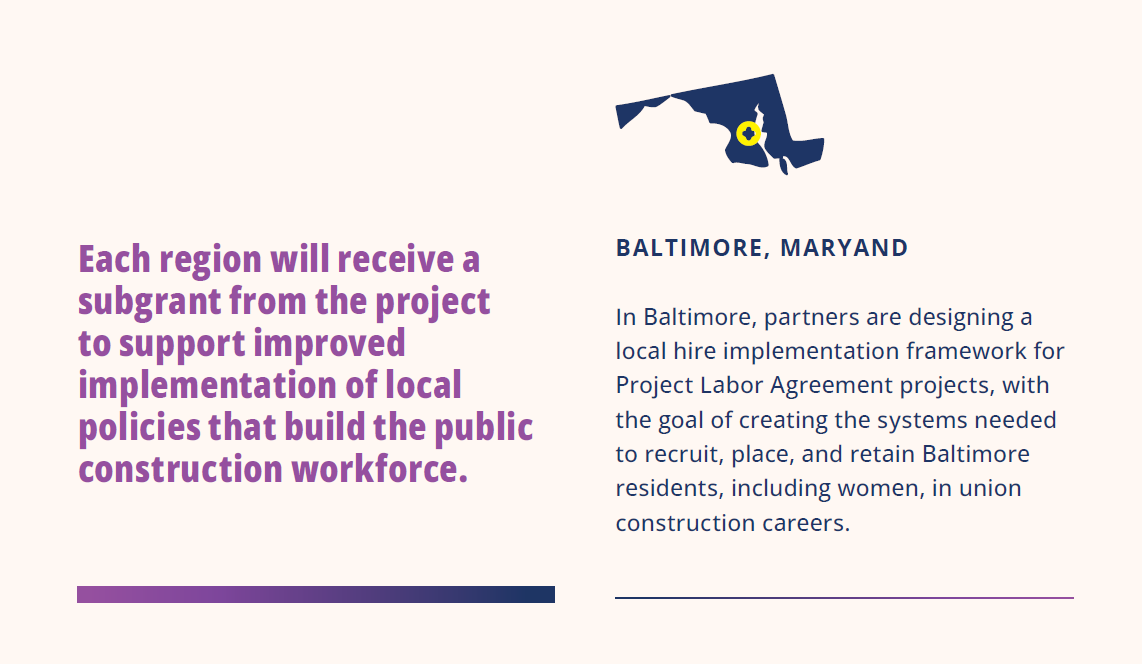
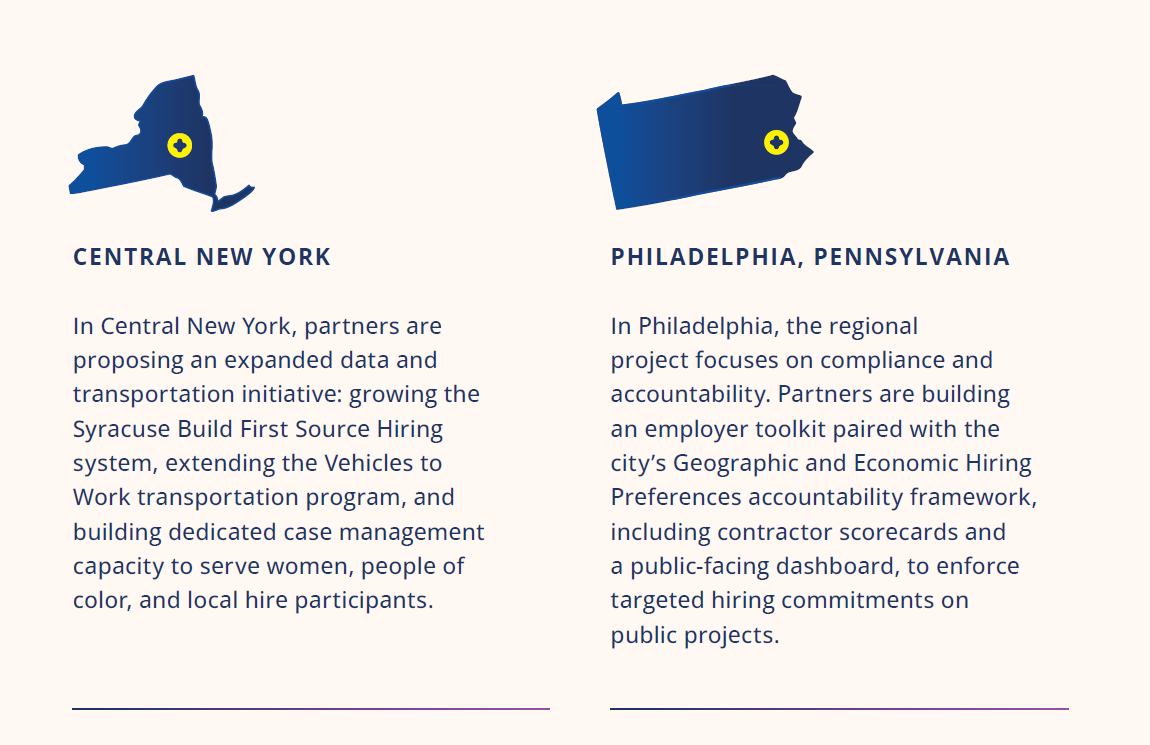
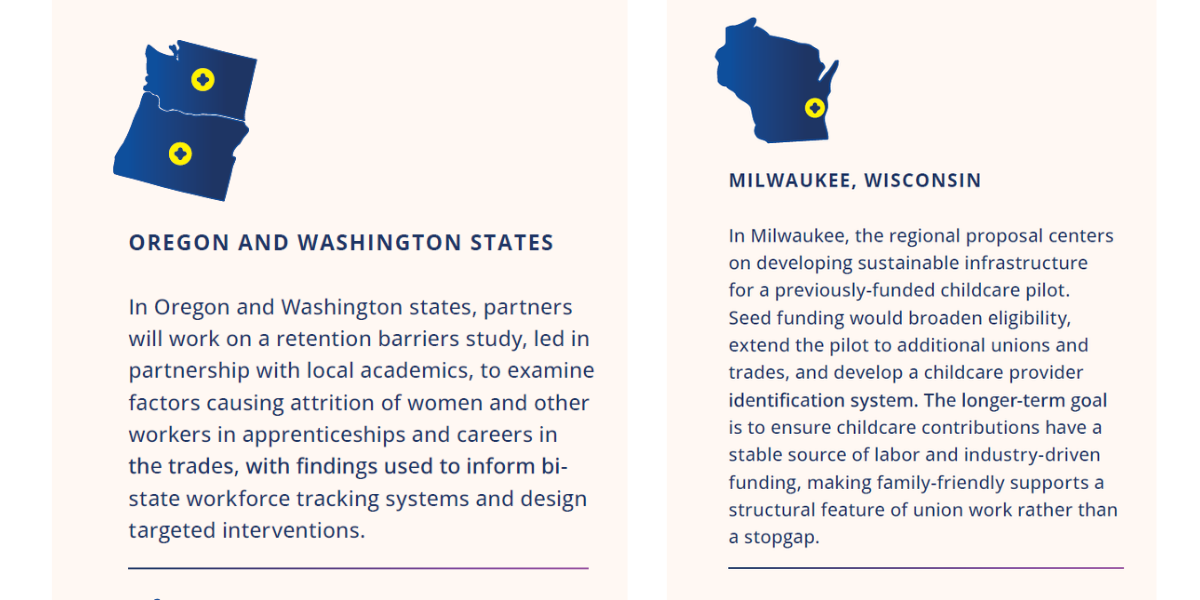
 Through the Infrastructure Pathways Project (IPP), ERA and TradesFutures are working directly with select apprenticeship readiness programs, community partners, local building trade councils, and city and state leaders to implement and document best practices to expand access to the construction workforce by improving recruitment and retention; and in doing so, meet a project’s need for a skilled and trained construction workforce. To support this work, the project has convened a cohort of five jurisdictions (Baltimore, Maryland; Central New York; Philadelphia, Pennsylvania; Oregon / Washington states; and Milwaukee, Wisconsin).
Each jurisdiction or project has a local or targeted hire policy in place that connects local workers to construction work opportunities and has identified different (though overlapping) challenges with implementation in their region. After conducting interviews with all of the cohort participants, IPP identified the need for tailored technical assistance in seven areas: Data Collection and Reporting; Convening and Monitoring Structures; Compliance Operations; Retention Strategies; Stakeholder Operations and Relationships; Meeting Local and Regional Needs; and Return on Investment Frameworks. Working with a number of subject matter experts, including tradeswomen advocates, IPP has begun to deploy individual coaching sessions with the regions.

The explosive growth of artificial intelligence is driving an unprecedented buildout of physical infrastructure, including semiconductor fabrication facilities and data centers. This boom is reshaping communities, labor markets, and environments across the United States.
As organizers, union representatives, and community advocates make clear, this is not an abstract technological transformation: it is a deeply material one, involving land, water, energy, toxic chemicals, and the bodies of workers. The AI supply chain begins in mines and ends in massive server farms, and at every link in that chain, decisions are being made right now about who benefits and who bears the costs. Trillions of dollars in private investment (augmented by public subsidies, tax incentives, and federal CHIPS Act funding) are flowing into these industries, with inadequate accountability to workers, communities, and the environment. The window to shape these investments is open, but it will not remain open indefinitely. That is why a coordinated, coalition-based effort with an explicit gender lens is imperative at this time.
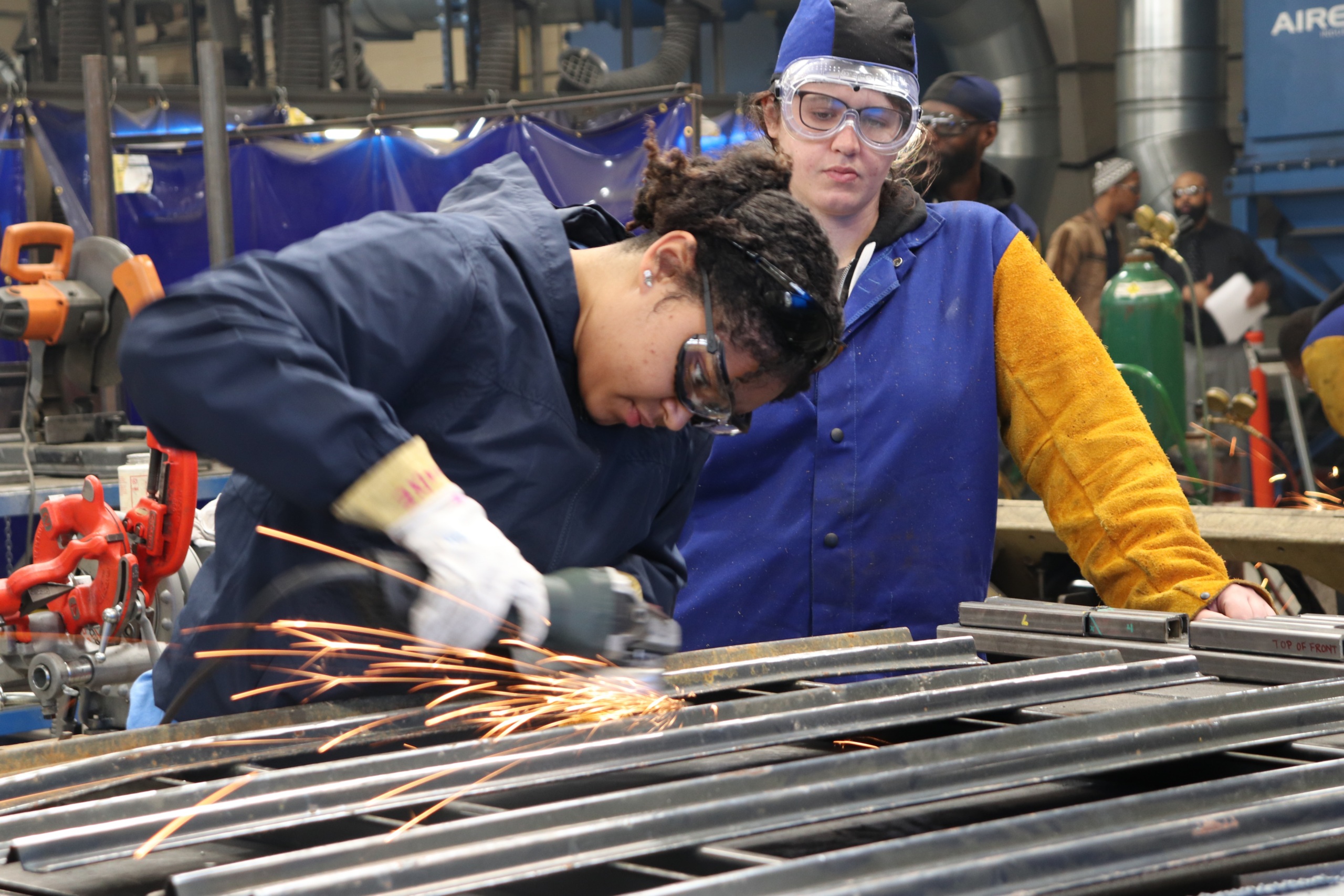 Women, and particularly women of color, face layering risks and compounding exclusions in the AI supply chain. Semiconductor manufacturing companies have a documented history of exposing workers to toxic chemicals, including PFAS, fluorinated gases, and a range of hazardous compounds used in cleanroom production. Research dating to the 1980s and 1990s in the United States, and subsequently documented across manufacturing sites in Asia, has linked these exposures to miscarriages, children born with developmental disabilities, elevated cancer rates, and other serious reproductive and health harms. As semiconductor manufacturing returns to the United States under the CHIPS Act, those harms threaten to return with it — unless intentional protections are built into the industry from the outset. Large scale commercial construction remains a field where women are dramatically underrepresented and where gender-based discrimination and harassment are persistent barriers to entry and retention. The tech sector has low union density (reportedly, only 1% is unionized), and the semiconductor manufacturing workforce is ripe for organizing given the absence of strong labor standards, which leaves the vast majority of workers without enforceable protections on wages, safety, or working conditions. Addressing these interlocking challenges requires coordinated action across labor, environmental justice, community organizations, and legal advocates, all focused on the places where this infrastructure is actually being built.
The organizing infrastructure of ERA and our coalition partners can serve as the foundation for the next steps of this work. Other coalitions already engaged in this effort are seeing successes. It is important to note that success with these campaigns must be defined by the local advocates; there is not one template or model that will necessarily work in every jurisdiction.

In Memphis, for example, communities organizing against Elon Musk’s xAI have won tangible victories on water use and property tax accountability. In Eastern Oregon, coalitions of environmental advocates and community members have secured an Amazon settlement worth $20 million for nitrate contamination of local water. In Chattanooga, a multiracial coalition of neighbors, union members, and civic advocates led by Jobs with Justice East Tennessee slowed a data center development and won amendments limiting its scope. In Syracuse, the Central New York coalition for community benefits agreements has communicated that winning at the table with major semiconductor manufacturers like Micron requires organizing elected officials as allies, then leveraging that political support to compel corporate accountability. In San Jose, Working Partnerships USA and the building trades have pioneered a model in which data center developers are required to build affordable housing heated and cooled by unionized workers. Across Missouri, a state leadership committee has coordinated seven simultaneous May Day actions to galvanize community and labor organizing in rural and urban areas. These steps forward share a common architecture: broad, unlikely coalitions; clear demands anchored in community benefits agreements or equivalent enforceable commitments; engagement with local elected officials as the critical pressure point on private developers; and a willingness to connect local fights to the larger political economy of corporate power and democratic accountability. What is missing is the coordination, resourcing, and gender-specific technical assistance that would allow these efforts to multiply and reinforce one another nationally.
The proposed coalition framework would institutionalize exactly that coordination, with an explicit and non-negotiable gender focus. Modeled on the Equity in Infrastructure Gender Hub, this effort could build a nationwide network linking national gender justice organizations with state and local community-based organizations already on the ground in the communities most affected by semiconductor and data center buildout.
The Network’s Core Functions Would Include:
Identifying and targeting the specific fabrication facilities and data center projects where advocacy is most ripe.
Supporting community-based organizations with technical assistance they currently lack, including FOIA requests, data analysis, environmental and health research, and legal support for enforcement.
Supporting the pursuit of collective bargaining agreements, community workforce agreements, or community benefits agreements as vehicles to secure strong, enforceable worker protections on a given project while also ensuring the surrounding community’s interests and priorities around that specific development are formally represented and addressed.
Developing and sharing model community benefits agreement language that includes specific, measurable commitments on local hire, wage standards, health and safety protections, environmental controls, and anti-discrimination and anti-harassment provisions.
Building worker pipeline programs that intentionally recruit women, especially women of color, into construction and manufacturing positions in the semiconductor and data center spheres while simultaneously ensuring those jobs are safe for women and all workers, with enforceable protections against toxic chemical exposure, reproductive health risks, and workplace discrimination.
Critically, the framework recognizes that pipeline efforts without safety and equity guarantees simply deliver more women into harm. The two must be built together. The legal enforcement infrastructure must be resourced alongside the organizing, because as we have seen time and again, paper commitments without enforcement do not make nearly the impact necessary.
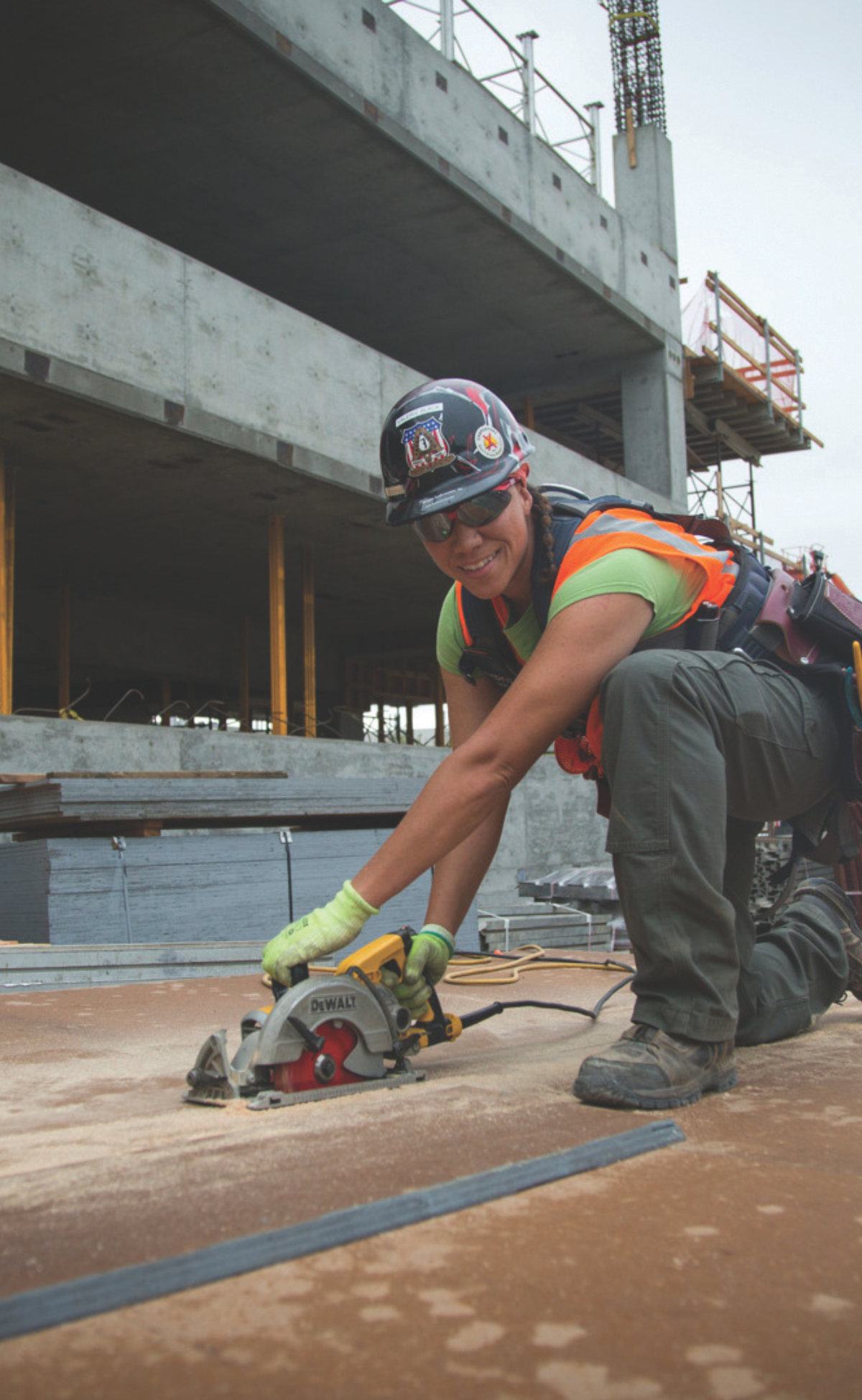 This work is urgent for reasons that go beyond any single project or community. The data center and semiconductor boom is, as organizers in Missouri have noted, potentially a bubble — one driven by speculative AI investment rather than proven returns, and one that could leave communities holding the costs of environmental degradation, depleted water supplies, strained electrical grids, and depressed property values when the private The AI and Data Center Opportunity investment moves on. The communities least able to absorb those costs are the same ones being promised jobs and tax revenue today. Women workers in cleanrooms and on construction sites are being asked to bear health risks that have not been adequately disclosed, in facilities built with public subsidies and managed without sufficient public accountability. The supply chain for AI runs through their bodies and their communities. Ensuring that it also runs through accountable democratic processes — through zoning boards, permitting hearings, tax abatement negotiations, community benefits agreements, and labor contracts — is both possible and necessary. The organizing models exist. The coalitions are forming. The missing ingredient is coordinated, well-resourced support for the community-based organizations and gender justice advocates who are closest to this work and best positioned to win it.
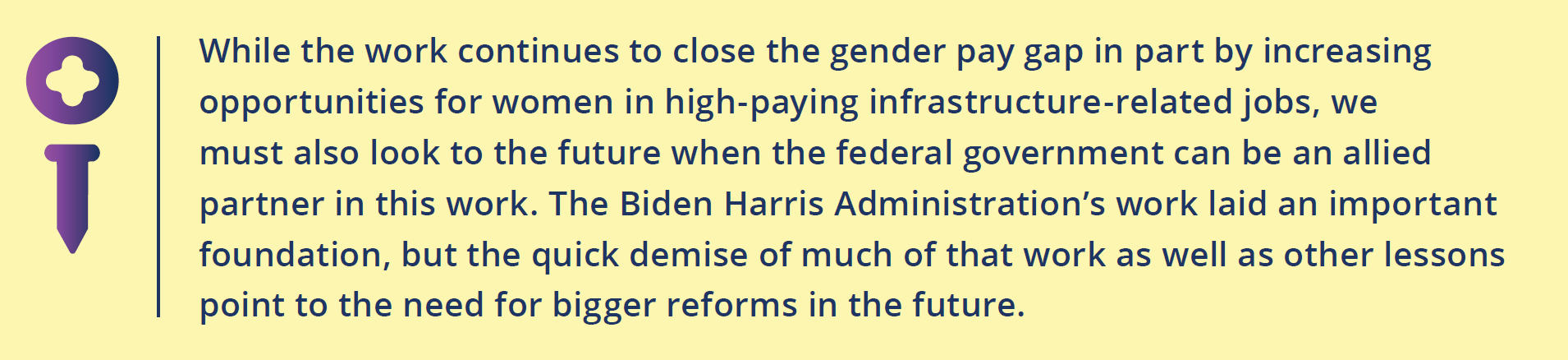
The most important lesson of the past several years is the indispensable power of coalitions. No single organization, no matter how skilled or well-resourced, can achieve the systemic change required to open high-paying infrastructure jobs to women and especially women of color. The LFFE coalition demonstrated that when advocates coordinate strategy, share intelligence about agency priorities, and collectively engage decision-makers, they punch far above their individual weight. The ability to convene state-focused infrastructure tables in states as diverse as Pennsylvania, Texas, Georgia, and California gave the coalition a geographic reach and policy influence that none of its members could have produced alone. As the coalition has evolved into the Coalition to Advance Workforce Equity (CAWE), it has carried forward this core insight: the goal is not to replicate what one organization does, but to multiply the impact of all.
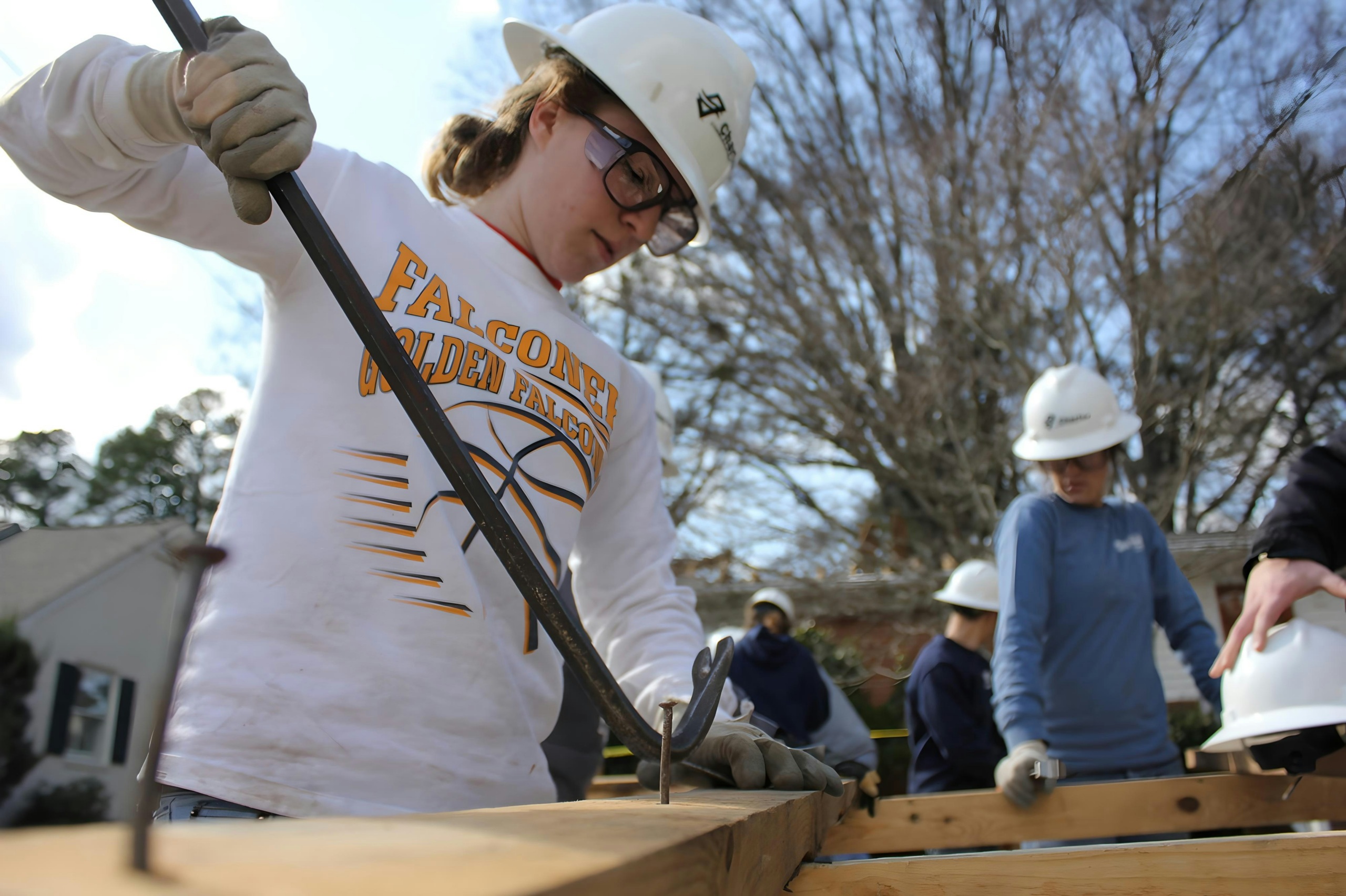 Coalitions also provide resilience in the face of political disruption. When the new federal administration eliminated the OFCCP Megaprojects program, organizations that had built deep state and local coalitions were far better positioned to absorb the blow and adapt. TexWIT pivoted directly to supporting tradeswomen credentialing. YWCA Columbus continued its childcare advocacy at the local level. The coalition infrastructure itself served as a shock absorber, ensuring that relationships and trust built over years were not lost simply because a federal program was cancelled.
Looking ahead, advocates must continue to deepen and broaden these coalitions with a particular emphasis on recruiting organizations that have roots in the communities where infrastructure investments are landing. The strongest coalitions are not those that simply include the right national organizations, but those that connect national strategy to local power. Community-based organizations across the country are well positioned to serve on multistakeholder project committees, such as future Megaproject EEO Committees, but lack the resources to do so, especially with the rollbacks of federal funding, including women-focused grant programs from the DOL’s Women’s Bureau. Philanthropy and industry should fund these state and local organizations alongside national coalitions, since funding gaps have historically kept less-resourced groups from taking on this role.
KEY TAKEAWAY: The indispensable power of coalition
No single organization, no matter how skilled or well-resourced, can achieve the systemic change required to open high-paying infrastructure jobs to women and especially women of color.
 Policymakers must invest adequately in workforce development as a foundational component of any major infrastructure or manufacturing investment. Federal and state governments that commit billions of dollars (or other financial assistance through loans, tax incentives, or other mechanisms) to build roads, bridges, semiconductor fabrication plants, and data centers must also commit proportionate resources to ensure that the workers building them reflect the communities that will be served. This means robust funding for pipeline programs that introduce women and workers of color to the construction trades and advanced manufacturing careers before they face discriminatory barriers of the hiring hall or the job site. Programs like the one run by the Houston Gulf Coast Building and Construction Trades Council, which provide hands-on apprenticeship readiness training alongside direct connections to union apprenticeship and employment are exactly the kind of investment that converts potential into paychecks.
At the same time, the abrupt loss of federal funding for programs like WANTO and FARE underscores why nonprofits and community-based organizations cannot afford to rely on any single funding source, however substantial, to sustain this work. Diversifying revenue across government, employer, and philanthropic sources is essential so that when federal support shifts or disappears, these organizations are not left starting from scratch, which is precisely why employers and private developers who depend on a steady pipeline of skilled, diverse workers have a direct stake in helping fund the pipeline programs their businesses require.
KEY TAKEAWAY: Equitable workforce development investment
Where governments and private industry are committing billions of dollars to infrastructure and manufacturing projects, they must commit commensurate resources to ensure the workers building these facilities reflect the communities that will be served.
Pipeline programs alone are not enough. Workers, and especially women, who disproportionately carry caregiving responsibilities, need supportive services to get to the job and stay there. Fresh Start Women’s Foundation and the Houston Gulf Coast Building Trades Council program both provide wraparound services in the form of assistance for childcare, transportation, housing, and more. These two programs are examples showing that without such supports, workforce programs fail the most marginalized workers at the precise moment they are closest to breaking through.
In addition, policymakers should fund sustained outreach and educational awareness efforts targeting workers who have historically been steered away from high-paying construction and manufacturing jobs (e.g. women and workers of color).
KEY TAKEAWAY: Workers need wraparound supports for success
Pipeline programs alone are not enough. Workers and especially women, who disproportionately carry caregiving responsibilities, need supportive services to get on the job and stay there.
The goal of expanding access to infrastructure jobs is undermined if those jobs are not actually good jobs. At minimum, this means living wages and family-sustaining benefits including healthcare, paid leave, and retirement security that enable workers to build genuine economic stability rather than simply escape poverty temporarily. It means workplaces that are physically safe, accessible, and free from the harassment and discrimination that has long driven women out of male-dominated industries. And it means meaningful incorporation of workers’ voices: the right to organize, to raise concerns without retaliation, and to participate in the decisions that shape working conditions. Policymakers should actively support and incentivize collective bargaining agreements, community workforce agreements, and community benefits agreements as vehicles to deliver on these commitments, since they combine enforceable worker protections with mechanisms for community input on the specific projects affecting them. Policymakers should structure grant requirements, contract conditions, and compliance frameworks so that public dollars generate public good, prioritizing projects and facilities that commit to employing a workforce that reflects the diversity of the communities in which they operate.
KEY TAKEAWAY: Bad jobs don’t help.
At minimum, new infrastructure jobs need living wages and family-sustaining benefits including healthcare, paid leave, and retirement security.
The new federal administration’s revocation of Executive Order 11246 has created a dangerous gap in the legal architecture protecting women and workers of color in infrastructure jobs. Congress must act to close it, especially since 1 in 5 U.S. workers is employed by an employer with federal contracts. As detailed in the report jointly published by ERA, the National Partnership for Women and Families, and 75 Million, Congress must codify non-discrimination requirements for federal contractors into statute, ensuring these protections cannot be eliminated with the stroke of a presidential pen. Codification would also create a more durable basis for enforcement and send a clear signal to employers that equity in the federal contractor workforce is a legislative mandate, not a matter of administrative preference. The urgency of this step has only grown as infrastructure investment continues to flow to private contractors, who are now operating with significantly reduced civil rights oversight.
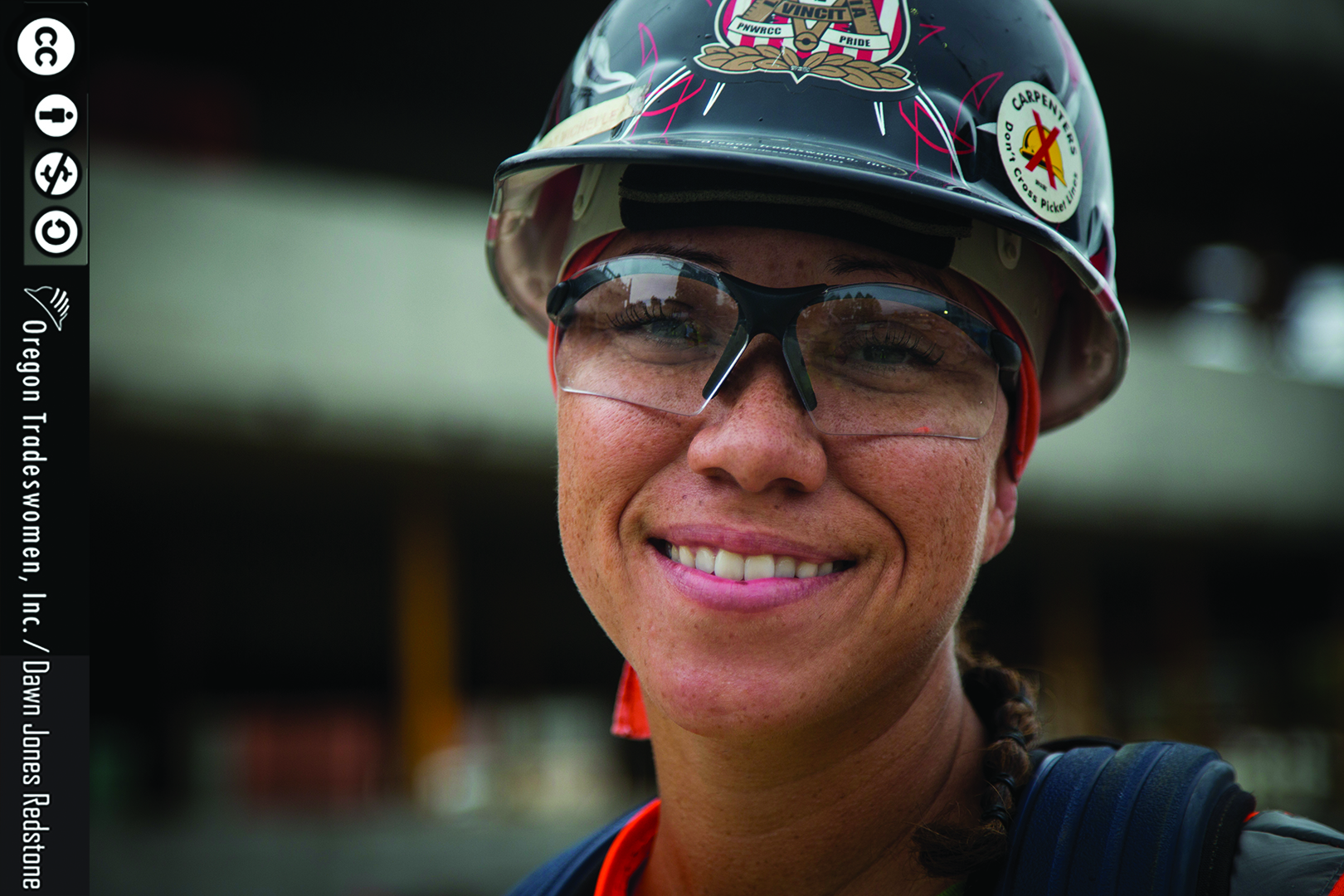 It is imperative that these requirements—whether called “affirmative action” or not—include obligations for employers to proactively take steps to identify and remediate barriers to equal opportunity. As the ERA/NPWF report details, OFCCP should provide guidance on how contractors can go about (1) conducting effective availability and barrier analysis to monitor equal opportunity in hiring, promotion, termination and compensation, among other practices, and (2) estimating or identifying demographic and compensation data for available and qualified workers by occupational, industry, and geographic area. In any new iteration, contractors must be accountable for maintaining a work environment free of harassment; and governments and employers must invest in efforts to eliminate harassment, intimidation, and coercion in contractor worksites and facilities.
A future federal administration must also withdraw actions taken by the current federal administration to discourage (or erroneously claim to make illegal) the use of diversity, equity, and inclusion-focused programs or policies. This includes executive orders, regulations, or sub-regulatory guidance, which require federal contractors and other recipients of federal financial assistance to certify that they do not operate equal opportunity programs, even where they are legal under existing civil rights laws or otherwise lawful actions to increase diversity, equity, and inclusion. This also includes the current federal administration’s actions to withdraw federal enforcement against discrimination under a theory of disparate impact liability.
KEY TAKEAWAY: Congress must close legal gaps.
Congress must codify non-discrimination requirements for federal contractors into statute, ensuring these protections cannot be eliminated with the stroke of a presidential pen.
 The Office of Federal Contract Compliance Programs (OFCCP), the Equal Employment Opportunity Commission (EEOC), the Wage and Hour Division (WHD), and the Occupational Safety and Health Administration (OSHA) are the primary federal institutions responsible for ensuring that infrastructure jobs are actually good jobs: that workers are paid what they are owed, that workplaces are safe, and that discrimination and harassment are addressed. Years of understaffing and underfunding have left these agencies unable to keep pace with the scale of federal contracting activity, and the current administration’s cuts have worsened the situation dramatically. The new federal administration’s devastation to critical federal staffing is no more apparent than with OFCCP: according to data from the Office of Personnel Management, OFCCP went from 458 employees in 2025 to 76 employees in 2026—an 83% reduction in staffing. Congress and future administrations should treat adequate funding for these agencies not as a discretionary matter but as a prerequisite for responsible infrastructure investment. Federal agencies like the Department of Labor’s Women’s Bureau also provided critical technical assistance to their sister federal agencies. In addition to providing guidance to OFCCP staff specifically on recruiting and retaining women in the building trades, the Women’s Bureau used to have its own regional staff assigned to serve on the Megaprojects EEO committees, ensuring that their local expertise was also utilized. Similar to the dramatic reduction in staff that OFCCP experienced, data from the Office of Personnel Management shows that the Women’s Bureau went from 55 employees in 2024 to a mere 20 employees in 2026—a reduction of nearly two-thirds of the office.
This resourcing imperative extends to federal agency civil rights offices as well: every recipient of federal financial assistance bears a legal obligation not to discriminate on the basis of race, sex, disability, and other protected characteristics, and those obligations are meaningless without the oversight capacity to enforce them.
KEY TAKEAWAY: Staff and fund workplace oversight federal agencies.
Years of understaffing and underfunding have left these agencies unable to keep pace with the scale of federal contracting activity, and the current administration’s cuts have worsened the situation dramatically.
The pace at which federal infrastructure dollars reach communities matters as much as the amount appropriated. When agencies lack the staff to process grants, review applications, execute contracts, and administer compliance requirements, the resulting delays stall job creation and leave workforce pipelines idle at precisely the moment they should be ramping up. Congress must therefore pair major infrastructure and manufacturing appropriations with dedicated funding to hire the program officers, grants managers, and compliance staff necessary to move money efficiently and responsibly. Equally important, agencies need flexible hiring authority, including the ability to bring on staff quickly, offer competitive terms, and scale teams up or down as funding cycles demand, rather than being bound by hiring processes designed for steady-state operations instead of the surge capacity that major infrastructure investment requires. Without this kind of staffing investment and hiring flexibility, even well-designed programs and enforceable standards will falter in implementation, leaving workers and communities waiting for opportunities that exist on paper but not yet in practice.
KEY TAKEAWAY: Congress must fund agencies to move quickly.
The pace at which federal infrastructure dollars reach communities matters as much as the amount appropriated.
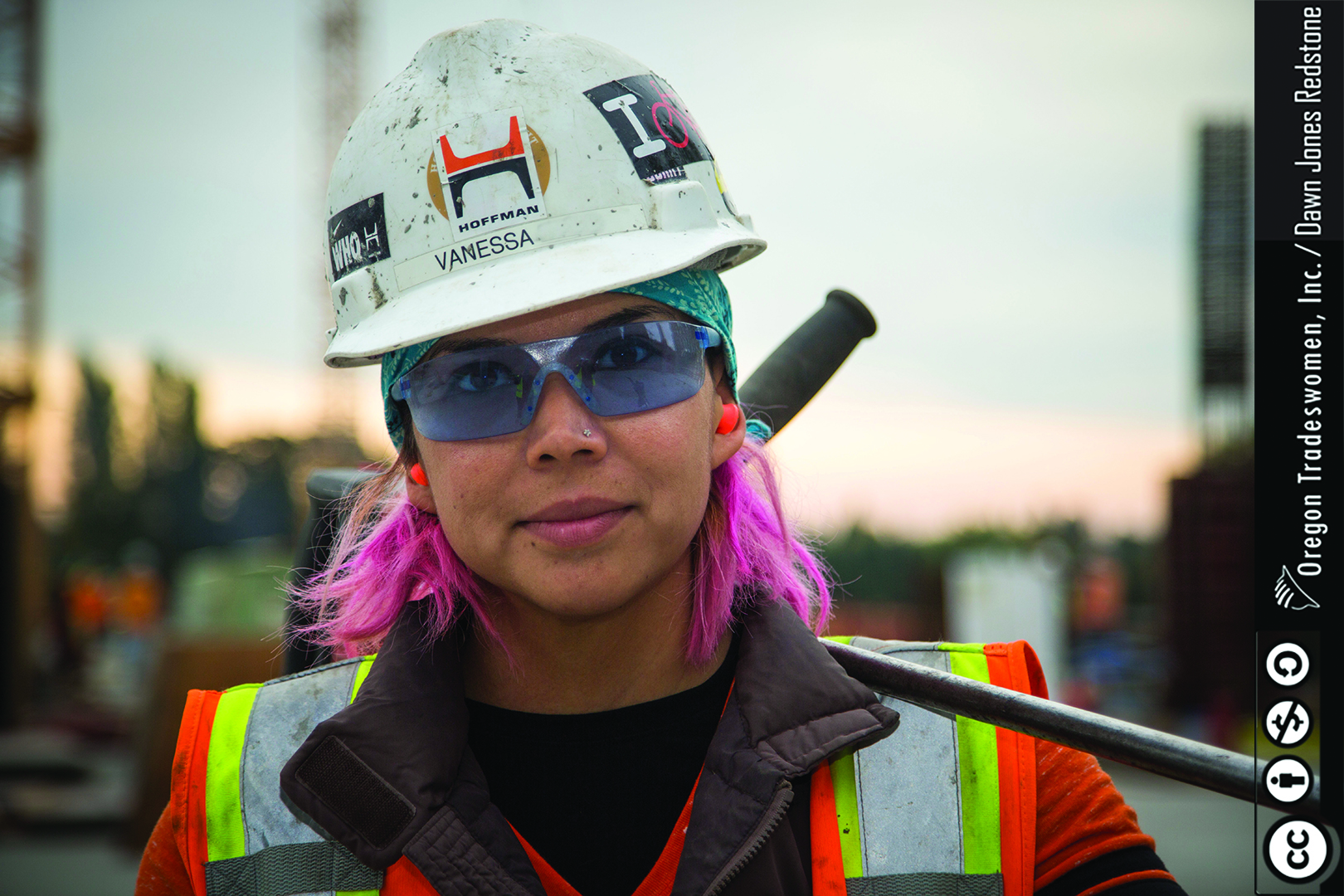 The OFCCP’s Megaprojects program, which mandated the creation of Equal Employment Opportunity committees on major construction projects, bringing together contractors, apprenticeship programs, community-based organizations, and worker advocates, was among the most promising mechanisms renewed during the Biden Administration for translating equity commitments into on-the-ground results. Its elimination removed critical infrastructure for accountability and community engagement at exactly the moment when hundreds of billions of dollars in federal investment were beginning to flow into local labor markets. One of the most crucial elements of the Megaprojects program was its proactive, front-end approach—the federal government was providing compliance assistance to the regulated community, ensuring that projects began with a legally sound foundation, opening the doors of opportunity without relying on a protracted enforcement process.
To ensure the program reflects the full scope of federal construction investment, federal agencies should be required to embed Megaprojects participation as a condition of funding for any large-scale construction project exceeding $35 million, so that the program draws from a pool of projects representative of federal investment across sectors (whether energy, transportation, housing, manufacturing, or otherwise) rather than a narrow subset determined by discretionary selection. Furthermore, OFCCP needs to have staff with expertise in construction hiring and real-time payroll data review, to effectively provide oversight.
Congress must also provide OFCCP with the funding and staffing necessary to expand its capacity beyond the limited number of projects it has historically been able to oversee.
KEY TAKEAWAY: OFCCP’s Megaprojects Program needs to be re-instituted.
The program’s mandated Equal Employment Opportunity committees on major construction projects was one of the most promising mechanisms for translating equity commitments into on-the-ground results.

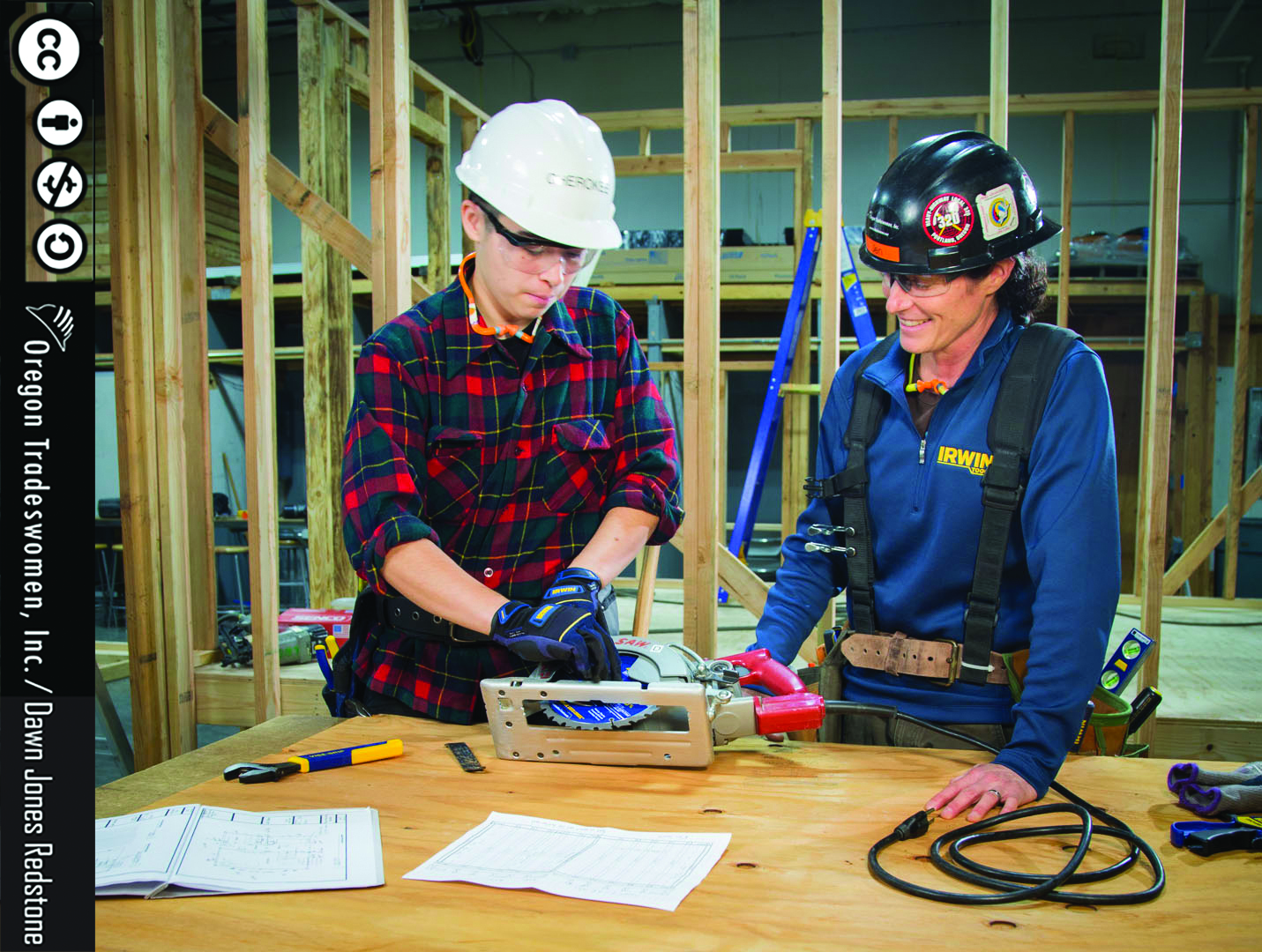 The work described in this report reflects both the extraordinary promise and the fierce headwinds of this moment for women in infrastructure. ERA and its partners have demonstrated that when coalition-building is treated as a core strategy, the result is an infrastructure of relationships, tools, and expertise that can survive political disruption and continue advancing equity, even when federal support retreats. From tradeswomen training cohorts in Phoenix and Houston, to Know Your Rights workshops in Baltimore, and state-level policy work through the Infrastructure Pathways Project, the common thread is clear: durable progress for women in high-paying infrastructure jobs requires coordinated action, community-rooted partnerships, enforceable standards, and wraparound supports that meet women where they are. As the next wave of infrastructure investment takes shape, in part driven by the AI and data center boom, ERA is committed to ensuring that the organizing models, coalition frameworks, and legal tools developed continue to grow and multiply. The goal has not changed: a workforce that reflects the full diversity of the communities being built, with good jobs, safe workplaces, and real economic opportunity for the women who have long been left out.

Support the movement for gender justice. Invest in our mission to end discrimination and sexual violence in our workplaces and schools with a gift to ERA.
Close and continue to EqualRights.org

Our communities need us now more than ever. Join an ERA email list for concrete ways you can defend gender, racial, and economic justice.
Learn what your rights are so you can navigate your situation and make the best decision for you.
Aprende sus derechos para que puedas navegar su situación y tomar la mejor decisión para ti.