Fighting to Ensure Taxpayer Dollars Do Not Fund Discrimination
ERA Is Fighting to Restore and Strengthen Critical Anti-Discrimination and Equal Employment Opportunity Protections in Federal Contracting
Sixty years of measurable progress in workplace equity in federal contracting was built on two things working in tandem: a legal mandate and an enforcement mechanism. In January 2025, on his first day in office, President Donald Trump revoked Executive Order 11246 — eliminating both. For nearly six decades, EO 11246 required federal contractors to not only comply with anti-discrimination law, but to proactively collect workforce data, identify barriers to equal opportunity, and take affirmative steps to address them. The Office of Federal Contract Compliance Programs (OFCCP) existed to hold them accountable. Following the revocation of EO 11246, in April 2025, the Administration placed hundreds of OFCCP staff on administrative leave, gutting the agency’s capacity to enforce what remains of federal contractor civil rights obligations. Together, these actions don’t just roll back a policy — they dismantle the architecture that promoted equal opportunity for women, people of color, and other underrepresented workers. ERA is fighting to rebuild it.
The dismantling continued. In July 2025, the OFCCP issued a Notice of Proposed Rulemaking (NPRM), proposing to formally rescind the regulations underlying EO 11246. The NPRM reasserted that the regulations are “null and void” and explicitly set forth that federal contractors are no longer required to comply with equal employment opportunity requirements that had been in force for nearly six decades.
The revocation of EO 11246 represents one of the most significant rollbacks of workplace civil rights protections in a generation. For more than 50 years, Equal Rights Advocates has fought for gender justice and economic equity through strategic litigation, policy advocacy, and coalition building — and ERA is fighting back on every front.
We are responding with the full range of tools at our disposal: lifting up the voices of impacted workers, submitting formal comments, strengthening coalition efforts, issuing public statements, and urging Congress to take legislative action to codify and permanently protect the rights that executive orders alone cannot secure.
Download our EO 11246 funder briefing deck →
Read ERA’s full statement on the dismantling of OFCCP →
ERA’s work on EO 11246 is part of a broader fight for gender justice and workplace equity.
Equal Pay Today
Fighting to close the gender and racial wage gap through federal and state policy.
National Taskforce on Tradeswomen’s Issues
Expanding women’s access to high-wage careers in construction and the building trades.
Stronger California
A statewide coalition advancing economic justice and workplace equity policies for California workers.
The Foundation, and What It Protected
Most anti-discrimination laws are reactive. A worker experiences discrimination, files a complaint, which triggers an investigation and, potentially, litigation. EO 11246 worked differently. It imposed affirmative obligations on federal contractors — requiring them not just to refrain from discrimination, but to actively prevent it and promote equal opportunity. Not only was EO 11246 broader than federal anti-discrimination law — it had teeth.
As amended, E.O. 11246 prohibited discrimination based on race, color, religion, national origin, sex, sexual orientation, or gender identity. Beyond that, it required covered federal contractors — companies employing roughly one in five American workers — to collect and analyze data to actively examine their own hiring, promotion, and pay practices and take proactive steps to advance equal employment opportunity as a condition of doing business with the federal government. E.O. 11246 also included important protections against pay discrimination. Because there is inadequate transparency around pay, unlawful pay disparities can be difficult to detect, and workers may not realize they are being paid less than their colleagues. To help uncover and address pay discrimination, EO 11246 protected employees of federal contractors who asked about, disclosed, or discussed their wages from retaliation. .
The Office of Federal Contract Compliance Programs (OFCCP) conducted scheduled compliance reviews that included visiting job sites, examining records, and holding employers accountable for what the data showed. This proactive model worked.
Relief secured for workers 2014-2024
$0M
Workers helped
0
Years of protection
0
U.S. workers covered
1 in 5
The Broader Impact of EO 11246
That combination of scope and enforcement power produced measurable results — results that are now at risk. During its active enforcement history, OFCCP secured hundreds of millions of dollars in financial remedies, back pay, and salary adjustments for hundreds of thousands of affected job applicants and employees. Between 2014 and 2024, OFCCP secured $260.8 million in relief for nearly 251,000 workers. In fiscal year 2024 alone, the agency settled 33 discrimination cases totaling $12.1 million and secured over 400 job opportunities for workers who had been shut out. Behind every dollar and every case is a worker who was harmed, shut out, fought back, and won — and a system that made that possible.
The federal contractors covered by EO 11246 employed more than 20 percent of the overall U.S. workforce. When the federal government holds these employers to a higher standard of fairness and equity, that has a ripple effect across the broader labor market. Research shows that companies subject to OFCCP oversight consistently employed more workers from historically excluded groups than comparable companies without federal contracts. That effect persisted even after contracts ended. Fair hiring practices, once built, tend to stick. When those standards disappear, the floor drops for everyone.
Expanding Access to Well-Paid Jobs in the Construction Trades
“They hired me because they were trying to meet the government’s requirements. But they kept me for 14 years because I was good at what I did.”
— Connie Ashbrook, tradesperson and EO 11246 beneficiary
Connie Ashbrook interview in 2025.
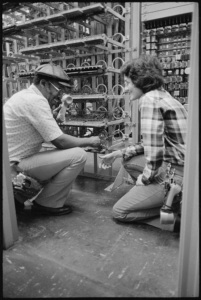
Connie Ashbrook worked in the construction trades for 14 years. Executive Order 11246 helped open up this career path for her.
“It used to be that you could only be male and be an apprentice,” Connie says. “So there were a lot of biases built into the apprenticeship system that were slowly being overcome.” EO 11246 helped change that, opening doors that had long been closed. And when women and other underrepresented groups were finally given those opportunities, they demonstrated exactly why these protections mattered: qualified individuals had been excluded not because of a lack of ability, but because of entrenched bias and discrimination. When afforded a fair chance, they succeeded and excelled in these roles.
Now that EO 11246 has been revoked, Connie is worried. “I’m very concerned that contractors won’t have the incentive to hire women. They’ll lose out on great workers.”
She’s right to be concerned. The order required federally-funded construction contractors to take concrete steps (such as outreach, data tracking, harassment prevention, on-the-job training) to ensure women, workers of color, and other individuals who were historically underrepresented due to discrimination, had access to these jobs. One study found that after the American Recovery and Reinvestment Act expanded EO 11246’s reach in construction, the share of those jobs held by women and workers of color increased directly as a result. For the tradeswomen and other workers who were finally given a chance to enter these jobs, this wasn’t just about a policy change– it created a pathway to economic security for themselves and their families.
ERA doesn’t work in isolation — and nowhere is that more evident than in the construction trades. For over 50 years, ERA has fought to increase access for women and other underrepresented groups into well-paid jobs in the trades. Through partnership with the National Taskforce on Tradeswomen’s Issues, we work to break down barriers to entry and retention through coalition-building, community engagement, and policy advocacy at the state and federal level. That coalition infrastructure is now one of ERA’s most important assets in the fight to restore what’s been lost.
That work is harder without the protection of EO 11246, but for us, it doesn’t stop.
“It is the experience of many women and people of color in the construction industry that without the pathways created by EO 11246, they would have been denied access to federally funded construction projects, closing off opportunities to build careers in this field.”
— Coalition Comment to OFCCP, September 2025
How ERA is Fighting Back
At a time when women and their families are facing increasing levels of economic insecurity, we must fight to restore the civil rights protections that have been taken away. The gender wage gap is already moving in the wrong direction. Women workers now earn, on average, 76 cents for every dollar paid to men, a disparity that has widened for the first time in 20 years. For women of color, the wage gap is even larger. Stripping these protections will make that worse and we are fighting back.
In September 2025, ERA co-led a formal coalition comment to OFCCP opposing the rescission of EO 11246’s implementing regulations, joined by more than 100 organizations including the National Women’s Law Center, the AFL-CIO, and the NAACP Legal Defense Fund. The coalition pushed back on three claims DOL made to justify dismantling these protections:
- DOL said the regulations were legally vulnerable following the Supreme Court’s Students for Fair Admissions decision. That ruling was narrow, applied only to race-based admissions in higher education, and has no application to the good-faith workplace programs EO 11246 required. In more than 47,000 compliance evaluations since 2004, not one contractor was ever cited for using placement goals as quotas.
- DOL said rescission would improve efficiency. ERA and its partners argued the opposite — fair hiring practices reduce costly turnover, expand the talent pool, and produce better outcomes for contractors and the federal government alike.
- DOL said it would create regulatory certainty. Rescinding decades of clear guidance leaves contractors with less clarity about their legal obligations, not more.
“For over 60 years, EO 11246 and its implementing regulations helped ensure everyone had a fair chance to access jobs created by taxpayer dollars. Dismantling this will make it harder to identify and break down barriers to equal employment opportunity.”
— Coalition Comment to OFCCP, September 2025
Read the full Coalition Comment here →
ERA is the founding partner of Equal Pay Today, a national campaign fighting to close the gender and racial wage gap. In 2024, ERA co-led a coalition comment supporting a proposed federal rule to ban salary history inquiries and require pay range disclosure from federal contractors. Salary history bans matter because prior pay discrimination doesn’t stay in the past — it gets carried from job to job, compounding over a career.
What Comes Next: Strengthening & Codifying These Protections into Law
For nearly 60 years, EO 11246 broke down barriers to employment for women and other underrepresented groups, helping to ensure that the hundreds of billions of taxpayer dollars spent on federal contracts each year were not used to support discrimination. It was revoked in a single day because it was always vulnerable — an executive order can be undone as quickly as it is signed.
That’s the fight we are in now. ERA is working with partners to make these protections permanent by urging Congress to codify the requirements EO 11246 into federal law. Statutory protections are more durable. They require an act of Congress to undo, not just a presidential signature. Workers deserve that security.
In May 2026, ERA, alongside the National Partnership for Women and Families and the 75 Million Campaign, launched an Issue Brief urging Congress to restore and strengthen protections established under EO 11246.
The Issue Brief outlines legislative recommendations across four key areas:
Non-Discrimination Requirements for Federal Contractors
E.O. 11246 included Title VII’s prohibitions on discrimination based on race, color, religion, sex, sexual orientation, gender identity and national origin, and included additional safeguards against pay discrimination. Legislation should codify these protections and explicitly address disparate impact, intersectional discrimination, and pay discrimination.
Preventing and Remedying Discrimination
The Executive Order required contractors to proactively review employment practices and address barriers to equal opportunity. Legislation should build on this framework by requiring data collection, analysis, and corrective action.
Applicability and Exemptions
E.O. 11246 applied to larger contracts and federally assisted construction but included a harmful religious exemption. Legislation should maintain appropriate contract thresholds and cover federally assisted construction contractors, but abandon the religious exemption.
Compliance and Enforcement
Chronic under-resourcing limited enforcement. Legislation should strengthen OFCCP by increasing funding and staffing, codifying compliance tools, and expanding enforcement authority, including subpoena power and additional remedies.
Read the full Legislative Recommendations here→
“For 60 years, every presidential administration, regardless of political party, has maintained these critical protections, which have expanded access to jobs for women and other groups, including in high-wage industries like the construction trades. Americans don’t want their hard-earned tax dollars funding discrimination.”
— Jessica Ramey Stender, Policy Director and Deputy Legal Director, Equal Rights Advocates
Sixty years of progress was not built overnight. It won’t be rebuilt overnight either. Equal Rights Advocates has spent more than five decades doing exactly this work — litigating, advocating, and building the coalitions that make change durable. We know how to fight this fight. And we’re not done.
Resources
Coalition Comment on EO 11246 Rescission
Submitted to OFCCP, September 2025
Equal Pay Today: Salary History and Pay Transparency Comment
Submitted to OFPP, March 2024
Recommendations to Congress: Restoring Federal Contractor Protections
ERA and coalition, May 2026
Under Attack: The Assault on Workplace Equity and What It Means for Working Women
ERA Report, February 2026