2026 Native Women's Equal Pay Day
A Wage Justice Agenda For Native Women
The State of Wage Justice for Native Women
November 2026
Download the report as a PDF
By Seher Khawaja, National Economic Justice Director, Equal Rights Advocates
Research support by Melissa Cook, Law Clerk, Equal Rights Advocates
The State of Wage Justice for Native Women
In the United States, Native women hold a unique position in our society, as the original matriarchs and stewards of the land, as visionary drivers of community and economic growth, and as catalysts for inclusive political change. Native women continue to sustain our communities as leaders, workers, spenders, and business owners. Their power is growing with voters turning out to change the face of political representation, increasing Native women’s leadership, and creating opportunities to drive a wage justice agenda that uplifts everyone.
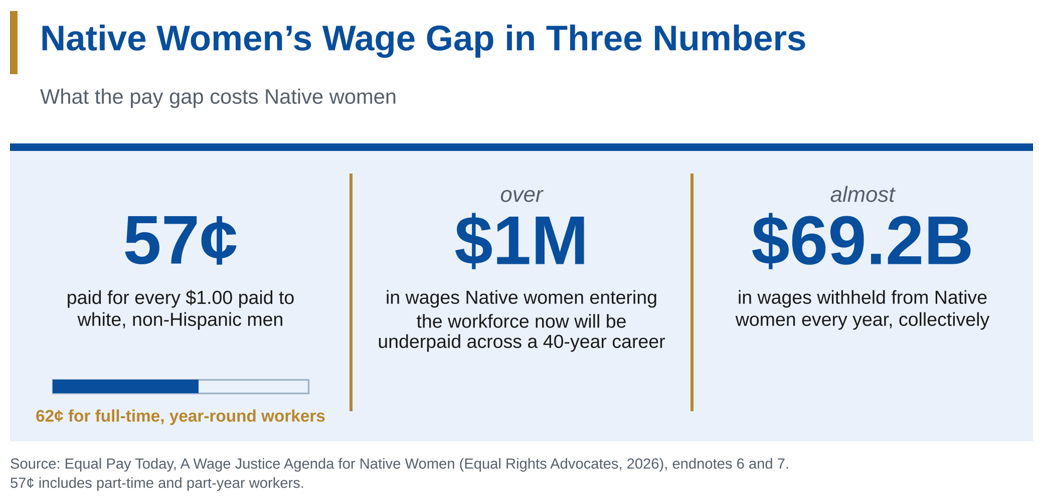
Today, nearly 70 percent of Native women are in the workforce,1 more than half of Native mothers are serving as breadwinners for their families,2 and more than one quarter of Native households are headed by women.3 In 2025, Native American and Alaska Native women owned an estimated 15,781 employer businesses, employing nearly 115,000 workers and generating $20.7 billion in revenue.4 Native women play a pivotal role in building their communities, preserving their culture, and strengthening tribal sovereignty.
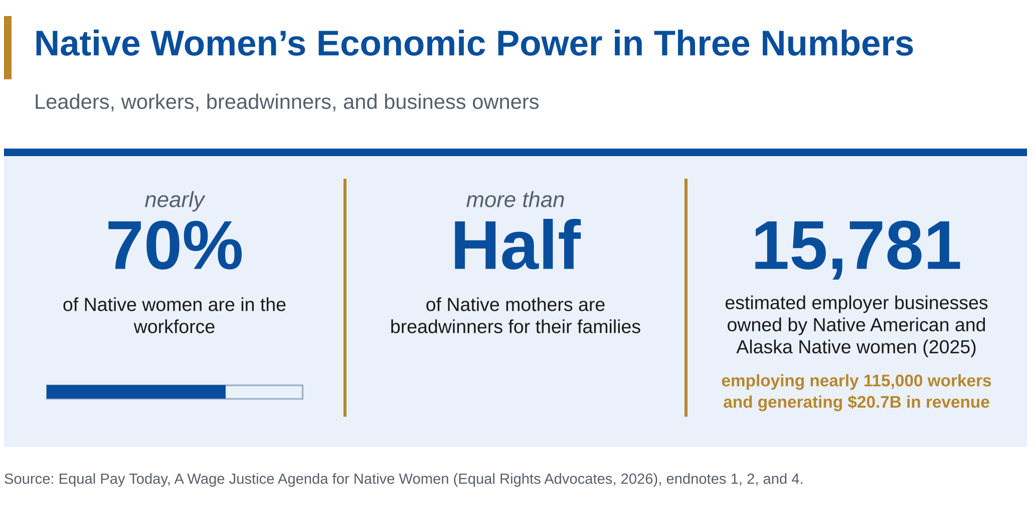
Despite these essential contributions, intersectional discrimination based on gender, race, ethnicity, culture, and socioeconomic status keeps Native women among the most economically insecure and underserved groups in the world. Native women face the lowest projected lifetime earnings of any demographic group over a 40-year career.5 Native women, working full-time, year-round are typically paid 62 cents per dollar paid to white non-Hispanic men. The gap widens to 57 cents per dollar when all earners, including part-time and part-year workers, are counted. At these rates, a Native woman entering the workforce now will be underpaid by over a million dollars across a 40-year career.6 Collectively, the pay gap withholds almost $69.2 billion in wages from Native women every year.7
Annually, these lost wages could cover more than 19 months of rent, 26 months of childcare, or 35 months of food.8 This inequity is one of the largest barriers to Native women’s economic security and economic power, and to living free from a longstanding epidemic of violence.
Closer Look: Equal Pay Today’s Platform for Change
Equal Pay Today (EPT), a project of Equal Rights Advocates (ERA), is a wage justice initiative uniting over 50 national, regional, state, and tribal organizations to eradicate pay disparities harming women and other workers based on characteristics including gender, race, ethnicity, LGBTQ status, and disability.
With a focus on low-paid workers and communities of color, Equal Pay Today is building a wage justice movement for all through policy advocacy, movement building, research, and strategic legal enforcement. Equal Pay Today’s comprehensive Policy Agenda addresses various contributors to the gap, including pay inequity and pay secrecy, lack of caregiver supports and caregiver bias, occupational segregation, poverty wages, and workplace discrimination.
Since its founding, Equal Pay Today has supported successful pay equity legislation in 44 states, helped lead advocacy in support of successful federal actions, and built upon these wins during the most recent legislative sessions across the country.
Closer Look: Countering Legacies of Colonialism, Genocide, and State-Sponsored Violence
Native women have survived ongoing legacies of colonialism, genocide, state-sponsored violence, and sexism, that together have created severe economic barriers and undermined their economic and physical security. Native communities have been subjected to proactive policies to deprive them of their land and resources and to assimilate, oppress, and erase their cultures.9 These policies include land displacement and forced relocation, removal of Native children from their families, limits on property inheritance and access to capital, restrictions and threats to tribal sovereignty and self-determination, underinvestment in tribal communities both on and off reservations, denial of civil rights and restrictions on voting, and depletion of their natural environment and resources.10 These policies successfully dismantled Indigenous economies, institutions, family structures and traditions, and wealth and have imposed multigenerational barriers aimed at eliminating Native identity, autonomy, and power. The lasting consequences of the destruction of Native economies followed by inequitable access to wealth accumulation, employment opportunities, and intergenerational economic mobility within the U.S. economy remain central towards the longstanding gender and race pay gap and broad disparities for Native women.11
Occupational Segregation & Poverty Wages
Native women, who are disproportionately concentrated in lower-paying occupations (twice their share of the overall workforce),12 are more likely to earn poverty wages and live in poverty. In 2024, 12.4 percent of Indigenous women employed in the nation’s 40 lowest-paying occupations lived below the federal poverty line and 38.9 percent lived in or near poverty.13 Today, American Indian and Alaska Natives have the highest poverty rate of all racial groups in the United States.14 More than half (51.9 percent) of employed Native women work in either service occupations or sales and office occupations.15 Many of these lower-wage industries are undervalued, underpaid, and are more likely to lack core benefits and have more variable incomes, unpredictable work schedules, fewer workplace protections, and little to no time off. Native women are also less likely than women overall to be covered by union contracts, limiting one avenue for negotiating higher pay, benefits, and safer working conditions.16
Closer Look: Pipeline from Residential Boarding Schools to Domestic Labor
Both federal and private residential boarding schools have historically trained Native women in housekeeping, caregiving, cooking, laundry, ironing, and sewing to channel them into low-paid domestic labor.17 Native girls have historically been removed from their communities and placed in white homes, farms, and businesses where they had little choice but to carry out domestic work in exchange for meager pay and room and board.18 This practice was another method to advance cultural assimilation and economic subjugation of Native communities.19
Structural Barriers to Employment and Economic Resources
Native women face high unemployment rates, which rose in 2025 from 5.9 percent to 7.1 percent.20 Native women working in rural and reservation communities face significant structural barriers to employment, including long distances between homes and to workplaces, limited access to childcare facilities, inadequate internet for remote work opportunities, and lack of access to public transportation.21 American Indians and Alaska Natives also face some of the
highest unbanked and underbanked rates in the country, limiting their access to credit, capital markets, and traditional wealth-building instruments. Funding constraints and continued disinvestment in Tribal communities further limit development of essential infrastructure to establish and expand local economic opportunities.22 These pressures contribute to approximately 80 percent of Native people living and working off reservation.23 Native women face disproportionate impacts, facing additional barriers to inheritance of land and property, access to credit, capital markets, and other economic resources and services.
High Rates of Violence
Native women report high rates of violence, with approximately 85 percent of Native women experiencing physical, sexual, or psychological violence in their lifetime.24 This type of violence has broad-based impacts on educational attainment, career stability, physical health, and economic mobility.25 In some parts of the country, Native women are murdered at a rate of ten times the national average,26 and 40 percent of all human trafficking victims in the U.S. are Native women.27 Economic insecurity and violence reinforce one another, limiting Native women’s ability to live and work safely, a cycle that government disinvestment in survivor services and in resources that strengthen Native communities only deepens.

Educational Barriers
Native women face substantial barriers to educational attainment due to numerous factors, including chronic underfunding of rural and reservation-based schools, high poverty rates, and the funneling of Native children into residential boarding schools. Instead of providing high-quality education, these schools are used to channel Native populations into industries that serve the interests of white Americans.28 Lack of economic resources and educational opportunity limit Native women from obtaining college degrees,29 with Native women on tribal reservations less likely to attend college or graduate.30
Disparities Across States
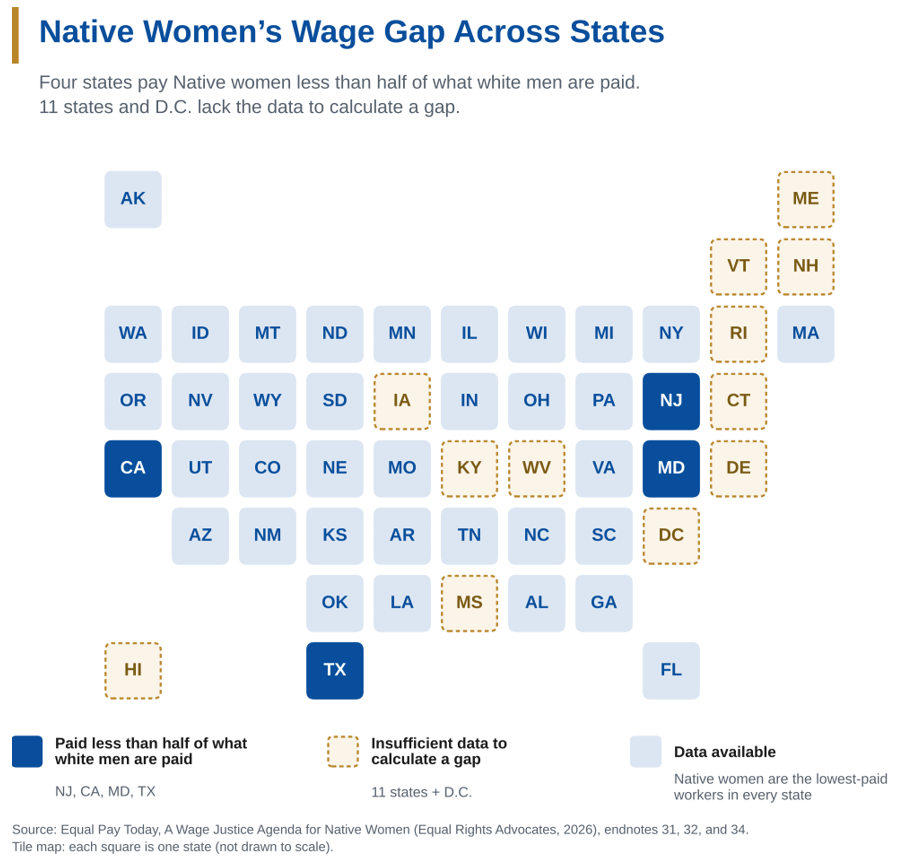
Native women are the lowest-paid workers in every U.S. state.31 Native women are paid less than half of what is paid to white men in at least four states: New Jersey, California, Maryland, and Texas.32 Two of these states, California and Texas are home to some of the largest Native populations in the country.33 Notably, at least 11 states plus Washington, D.C., lack sufficient data to calculate the wage gap for Native women,34 highlighting the need for improved data collection for Native populations.35
Disparities Across Tribes
Native women in every tribe for which data is available experience significant wage gaps compared to white men.36 When looking across tribes, Tohono O’odham women experience the largest gap and are typically paid around $30,000 less per year than white non-Hispanic men.37 Even the smallest gap is still sizable at $14,000, for Alaskan Athabaskan women.
Closer Look: Economic Mobility and the Democratic Process
Despite facing numerous barriers to advancement, Native women demonstrated that they hold political power in the United States when they show up to the polls. In 2024, Native women voters were concerned about the cost of living and were in support of policies that address economic, health and safety needs.38 This included policies to strengthen protections against gender-based violence, harassment, and discrimination; increasing supports for caregivers and strengthening equal pay laws. The 2026 midterms saw a record number of Native women in political representation across leadership positions. Civic engagement that prioritizes economic security and power—through voting, running for office, serving as elected officials, and increasing representation in political leadership—is a critical lever for Native women to be heard and to build political power, economic security, and wealth.
Closer Look
The federal administration’s actions are exacerbating longstanding drivers of inequity for Native women. These assaults include:
- Funding cuts and grant rescissions across agencies, including the Department of Justice and Department of Health and Human Services, that have scaled back essential services for Native communities.39 Cuts are impacting services for survivors, including safe housing, counseling, transportation, direct cash assistance, court accompaniment for survivors of crime and violence, and advocacy for victims of elder abuse, people with disabilities or people who had been trafficked.
- Assaults on data collection that risk further erasing Native communities. This includes:
- Revising data collection methods to increase reliance on data aggregation that further limits data on Native populations.40
- Updating the federal workforce database to exclude available data on gender, race, ethnicity, and disability, making it harder to track Native women’s employment outcomes and identify discrimination.41
- Efforts to revise the Census to change the way residency is captured and to stop collecting race and ethnicity data.
- Substantial cuts enacted under the “One Big Beautiful Bill Act” to essential benefits, including SNAP, Medicaid, Medicare, ACA premium tax credits, and the Child Tax Credit. These cuts have drastic impacts on Tribal citizens, who experience high rates of poverty and some of the highest rates of food insecurity of any major demographic group.
Shrinking and staff cuts to the Department of the Interior’s Indian Affairs unit, resulting in impaired service delivery.
“Achieving equal pay and financial sovereignty is imperative, as Native women are the primary breadwinners and backbone of our families, communities, and Tribal nations.
– Ervina G. Castillo
Enrolled member of the Diné Nation; Operations Manager, Native Women Lead
Urging Congress to Protect Native Women and Survivors in the FY27 CJS Appropriations Bill
As part of these efforts, Equal Pay Today is advocating for Congress to reinstate and increase funding for Native survivors. Native women experience some of the highest rates of violence and widest pay gaps in the country, yet federal funding cuts and grant rescissions are threatening the vital services they rely on and forcing community-based domestic violence and sexual assault programs to turn survivors away when they need help most. As part of a national action campaign, Equal Pay Today is urging Congress to reject harmful cuts to victim services and pass a strong FY27 CJS bill that restores and increases funding to Tribal survivor safety programs under the FY27 Commerce, Justice, Science (CJS) appropriations bill, which funds the Department of Justice’s Office on Violence Against Women (VAWA) and Office for Victims of Crime (VOCA).
A Comprehensive Wage Justice Agenda for Native Women
“When Native women’s work is underpaid and our disappearances are met with indifference, the message is the same: our lives are valued less. Equal pay and justice for our missing and murdered relatives are connected by a demand that should never have been necessary: that Native women’s labor, safety, and lives be valued equally. Our worth has never been in question. This country’s willingness to honor it has.
– Lynnette Grey Bull
Hunkpapa Lakota, Dakota, and Northern Arapaho leader; Founder and Executive Director, Not Our Native Daughters
Closing the wage gap would put billions of dollars back into the hands of women who sustain their families, invest in their communities, and build intergenerational wealth that strengthens tribal economies.
Getting there takes a comprehensive approach that centers the unique experiences of Native women and builds sustainable solutions, such as greater visibility for Native women in every sector, better access to resources, fair hiring practices, and pathways to leadership and higher-paying jobs.
The persistent and sizable pay gap for Native women is not a coincidence. The gap is the result of a longstanding legacy of colonialism, genocide, and state-sponsored policies that have destroyed Native economies and forced Native women into low-paid labor. Native women hold the solutions to address these gross injustices. Correcting these structures means centering the voices and experiences of Native women, investing in Native communities, and raising wages for Native women.
Over the past decade, Equal Pay Today has worked with women in these communities to build community power behind policy reforms that address the key contributors to the pay gap harming Native women workers. These solutions, set forth in our Policy Agenda, not only defend against a hostile federal administration; they are paving a new vision for valuing the labor of Native women and creating necessary pathways. This playbook of legislative solutions can and should be replicated across states towards the goal of building long-term consensus to codify these protections in federal legislation.
A comprehensive wage justice agenda for Native women includes:
-
Confronting systemic discrimination barring many Native women from accessing equal opportunity.
The EPT Policy Agenda works to preserve and advance key tools to address systemic discrimination. This includes opposing the Equal Employment Opportunity Commission’s (EEOC’s) attempt to eliminate the longstanding EEO-1 data collection, which is essential to anti-discrimination enforcement, and strengthening state protections to codify disparate impact liability. Disparate impact protections allow employees to challenge workplace practices that appear neutral on their face, but result in biased outcomes for women, people of color, and other protected groups.
-
Tackling job segregation into low-wage industries.
Native women face high rates of occupational segregation that has pushed them into essential yet undervalued occupations that severely limit their earnings and prevent them from achieving basic economic security. The EPT Policy Agenda sets forth a roadmap to raise wages in underpaid and undervalued industries where women and workers of color are disproportionately represented. This includes fighting to preserve federal data collections that are critical for identifying trends in occupational segregation and advocating for the Fair Pay Act, a federal bill that would require employers to provide equal pay to employees for comparable or equivalent work helping to address wage differentials due to occupational segregation. Equally important is the creation of pathways for Native women to enter male-dominated higher paying industries with union protections though initiatives like Equal Rights Advocates’ Infrastructure Pathways Project and the advocacy of the National Taskforce on Tradeswomen’s Issues, a project of ERA.
“Treating Native women as an afterthought in the skilled trades reduces workforce diversity to mere tokenism. It actively perpetuates economic erasure, barring Indigenous women from safe, living-wage careers, generational stability, and the leadership to build our own futures and infrastructure with our own hands.
– Jessenia Rivera
Co-Founder, International Native Women in Trades (INWIT); Stationary Engineer with the International Union of Operating Engineers (IUOE) Local 30
-
Promoting equal pay by strengthening pay equity laws, implementing salary history bans, and prohibiting retaliation.
Native women face discrimination based on intersecting factors that drive hiring biases and unequal treatment on the job. These dynamics limit advancement, thwart mobility, and bring down wages. To address these inequities, Equal Pay Today advocates for state and federal legislation to close loopholes in existing pay equity laws, mandate equal pay for equal or substantially similar work, and prohibit the use of prior salary in hiring and salary-setting. This includes ongoing advocacy to enact the Paycheck Fairness Act and support that has resulted in dozens of pay equity legislative wins at the state level.
-
Demanding pay transparency to empower workers with leverage and hold employers accountable.
Secrecy around pay prevents Native women from identifying gender or race-based wage disparities and advocating for fair pay. When pay practices remain secret, employers can maintain discriminatory practices absent scrutiny. Equal Pay Today supports passage of the federal Salary Transparency Act and leads efforts to support states to enact pay transparency laws.
-
Establishing caregiver protections and reducing caregiver penalties.
Native women are disproportionately tasked with unpaid caregiving responsibilities, while carrying the unique, ongoing impacts of family separation policies. Native mothers face punitive state interventions that remove Native children from their families, and they work to keep their families together, safe, and secure while resisting practices that harm families and perpetuate a legacy of cultural genocide aimed at eroding and eliminating Tribal identity. It is therefore essential that Native women have the benefits they need to work and care for their families. Wage justice for Native women requires caregiver protections, including affordable childcare, paid family leave, and paid time off. Equal Pay Today supports efforts to enact the federal FAMILY Act to establish paid family and medical leave benefits; the Healthy Families Act, to establish paid sick leave; and the Job Protection Act and the Caring for All Families Act to expand existing leave protections nationwide. Equal Pay Today also supports state legislative efforts to achieve these protections.
“ The barrier is not caregiving. It is an economic system that depends on Native women’s unpaid labor while failing to recognize or support it. Native women should not have to sacrifice their own economic security to care for their communities. Paying them less only deepens the injustice and economic inequity.
– Gina Jackson
Western Shoshone and Oglala Lakota; Co-Founder & CEO, Return to the Heart Foundation
Closer Look: Economic Mobility and the Democratic Process
The Truth and Healing Commission on Indian Boarding School Policies Act of 2025 would establish a Commission on Indian Boarding School Policies to investigate the impacts and ongoing effects of the Indian Boarding School Policies (federal policies under which American Indian, Alaska Native, and Native Hawaiian children were forcibly removed from their family homes and placed in boarding schools). The Commission would be tasked with developing recommendations to address impacts of removals, including discontinuance of removal of American Indian, Alaska Native, and Native Hawaiian children from their families and tribal communities by state social service departments, foster care agencies, and adoption agencies.
-
Raising the wage floor, eliminating poverty-wages, and challenging wage theft.
Native women face high poverty rates, and too many Native women earn poverty wages. Wage justice cannot be achieved without addressing the inequities created by job segregation and its role in driving the wage gap without increasing the wage floor. Equal Pay Today supports federal and state legislation to increase the minimum wage, eliminate the tipped minimum wage, and preserve and expand funding for public benefits. Current proposals include A Living Wage for All Act and the Raise the Wage Act.
-
Creating robust workplace protections against sexual and other forms of harassment and discrimination that drive and exploit economic vulnerability.
Native women workers face high rates of sexual violence and harassment. Sexual harassment has broad economic consequences that drive pay inequity, imposing trauma, forcing women out of their jobs, impacting job performance, limiting job opportunities and advancement, and often resulting in further discrimination and retaliation. Equal Pay Today supports the federal BE HEARD in the Workplace Act, which would strengthen the law to better address and prevent workplace discrimination and harassment, including by covering all workers, regardless of employer size, and eliminating the tipped minimum wage, which places tipped workers at greater risk of harassment by customers. At the state level, Equal Pay Today supported bills to strengthen protections against workplace harassment in Arizona, California, Georgia, and Maryland, with success in California.
-
Strengthening enforcement and challenging attacks on federal infrastructure and funding.
Equal Pay Today strongly opposes the gutting of our nation’s civil rights enforcement agencies and other critical programs and engages in robust federal defensive work to stem the current administration’s attempts to dismantle existing public benefits, civil rights and labor protections, and enforcement. This includes advocacy to safeguard and restore federal enforcement agencies like the Office of Federal Contract Compliance Programs (OFCCP) and the Equal Employment Opportunity Commission (EEOC), to preserve critical data collections carried out by the EEOC and the U.S. Census Bureau, and to oppose the rescission of critical guidance and federal regulations clarifying enforcement of core civil rights workplace protections.
ERA Partner Spotlight
Native Women-Led Organizations Spearhead Initiatives to Center Needs of Native Women
Native-women-led organizations play a critical role in developing concrete community-based solutions to address longstanding barriers to achieving economic security and physical safety for Native women. Here are some organizations leading these efforts:
| Return to the Heart Foundation is addressing the lasting consequences of colonization and generational trauma through Indigenous-led initiatives focused on civic engagement, climate justice, economic development, and cultural revitalization. Recognizing that Native women’s economic security is inseparable from the well-being of their communities, the Foundation works to expose structural inequities that undermine Native women’s economic security while investing in Indigenous women as leaders, entrepreneurs, advocates, and agents of change. Through initiatives such as its Society Fellowship, the foundation supports Native women-led economic activity, expands opportunities for entrepreneurship and employment, and amplifies Indigenous women’s leadership. |
| Not Our Native Daughters (NOND) is dedicated to ending the trafficking, exploitation, and murder of Indigenous Peoples by advancing prevention, youth leadership, cultural reclamation, policy change, and community-driven solutions. NOND empowers Indigenous communities by advocating for justice, raising awareness, and providing support to families affected by violence. Through policy reform, community engagement, and healing practices, the organization is committed to creating a future where Indigenous women and youth are safe, supported, and empowered to lead the fight for justice, equity, and healing. NOND leads family support programs providing emergency financial assistance, human trafficking response, culturally responsive healing, and legal information. As an Equal Pay Today Member, NOND has played a critical role in uplifting the interconnected roles of violence and economic insecurity and the importance of wage justice in addressing these dynamics. |
| Coalition to Stop Violence Against Native Women (CSVANW) engages in social change to eradicate violence against Native women and children. By providing support, education, and advocacy, CSVANW leverages collective strengths, power, and unity towards the creation of violence-free communities. CSVANW serves as a resource for Native advocates working in domestic violence, sexual assault, dating violence, stalking and sex trafficking in New Mexico’s tribal communities, providing training, advocate support, technical assistance and policy advocacy. CSVANW has helped develop and promote tribal, federal, state and local legislation, and policies that cultivate best-practices for responding to violent crimes against Native women and children. As an Equal Pay Today Member, CSVANW has been an essential voice in advancing wage justice in efforts to end violence against Native women and children. |
| Native Women Lead (NWL) is working at the intersection of economic justice, racial equity, and rematriation—restoring power and resources to Indigenous women and communities. Recognizing that conventional financial institutions fail to reflect Indigenous values and experiences and create barriers to access, NWL is working to transform how economic opportunity is created and distributed. Through its Matriarch Funds, NWL has piloted three relationship-based lending programs supporting Indigenous women-owned businesses across New Mexico, Arizona, Colorado, and Utah. These initiatives provide access to affordable capital alongside business development support, prioritizing community relationships, and collective prosperity over traditional lending standards. Central to this work is NWL’s innovative Five R’s of Rematriation, an alternative to the conventional Five Cs of Credit that centers relationships, community investment, restoration, regeneration, and economic transformation. By putting Native women at the center of financial decision-making, NWL is challenging discriminatory lending systems and creating opportunities for Indigenous women to build businesses, generate wealth, and strengthen tribal economies. |
| The Minnesota Indian Women’s Resource Center (MIWRC) provides a broad range of programs designed to educate and empower Native women and their families, and to inform and assist those who work providing services to the community. Located in the Phillips neighborhood of Minneapolis, MIWRC serves the third largest urban American Indian population in the United States. The organization provides a range of services to advance wellbeing and address community needs including affordable housing, chemical dependency, mental health care, and cultural resilience and healing. At the heart of its work, MIWRC aims to empower Native women and families to exercise their cultural values with integrity, and to achieve sustainable lifeways, while advocating for justice and equity. |
Citations & Footnotes
| To Cite This Report
Khawaja, Seher, with research support by Melissa Cook. “A Wage Justice Agenda for Native Women: 2026 Native Women’s Equal Pay Day.” Equal Rights Advocates, November 2026. http://www.equalrights.org/wp-content/uploads/2026/11/Native_Womens_Equal_Pay_Day_Report_2026.pdf |
- Britnee Johnston, Miriam Jorgensen, Kyra James & Stephen Cornell, The Employment Situation of Native Americans, Native Nations Inst., Univ. of Ariz. (Nov. 2024), https://nni.arizona.edu/sites/default/files/2024-12/The-Employment-Situation-of-Native-Americans.pdf.
- Nat’l P’ship for Women & Fams. & Return to the Heart Found., Native American Women and the Wage Gap (Nov. 2025), https://nationalpartnership.org/wp-content/uploads/native-american-women-wage-gap.pdf.
- Id.
- Wells Fargo, The Impact of Women-Owned Businesses (2026) https://www.wippeducationinstitute.org/_files/ugd/2f8f8e_999289ec47da4982bb1f0e34f9f48ac2.pdf.
- Payscale, 2026 Gender Pay Gap Report, https://www.payscale.com/featured-content/gender-pay-gap (last visited Nov. 16, 2026).
- Nat’l Women’s L. Ctr., The Lifetime Wage Gap by State for Indigenous Women (Mar. 24, 2026), https://nwlc.org/resource/the-lifetime-wage-gap-by-state-for-indigenous-women/.
- Nat’l P’ship for Women & Fams. & Return to the Heart Found., supra note 2.
- Id.
- Gina Jackson, Beyond the Numbers: The Reality of Native Women’s Pay Disparities, Nat’l P’ship for Women & Fams. (Nov. 12, 2024), https://nationalpartnership.org/beyond-the-numbers-reality-of-native-womens-pay-disparities/.
- See Randall Akee & Emilia Simeonova, Beyond the Conventional Narrative: Economic Heterogeneity and Human Capital Among American Indians, Nat’l Bur. of Econ. Research (Sept. 2026), https://www.nber.org/system/files/working_papers/w35730/w35730.pdf.
- United Nations Office of the Special Adviser on Gender Issues and Advancement of Women and the Secretariat of the United Nations Permanent Forum on Indigenous Issues, Gender and Indigenous Peoples’ Economic and Social Development (Feb 2010), https://www.un.org/esa/socdev/unpfii/documents/BriefingNote2_GREY.pdf.
- Sarah Javaid, Hard Work Is Not Enough: Women in Low-Paid Jobs, Nat’l Women’s L. Ctr. (June 2026), https://nwlc.org/wp-content/uploads/2023/07/Hard-Work-Is-Not-Enough-Women-in-Low-Paid-Jobs-1.pdf.
- Id.
- Joseph Dean, Racial Wealth Snapshot Series: Economic Outlook Overview for Native Americans, Nat’l Cmty. Reinvestment Coal. (June 25, 2026), https://ncrc.org/racial-wealth-snapshot-series-economic-outlook-overview-for-native-americans/.
- U.S. Census Bureau, Sex by Occupation for the Civilian Employed Population 16 Years and Over (American Indian and Alaska Native Alone), Am. Cmty. Surv., 2024 ACS 1-Year Estimates Detailed Tables, tbl. B24010C, https://data.census.gov/table/ACSDT1Y2024.B24010C?moe=true.
- Inst. for Women’s Pol’y Rsch., A Decade with No Improvement: Native Women and the Wage Gap (Fact Sheet IWPR No. C504, Sept. 2021), https://iwpr.org/wp-content/uploads/2021/09/Native-Womens-Equal-Pay-Fact-Sheet-2021_FINAL.pdf.
- A History of Domestic Work and Worker Organizing: Menial Labor as Civilization, Domestic Workers’ HerStories, https://www.dwherstories.com/timeline/menial-labor-as-civilization (last visited Nov. 16, 2026); Caitlin Keliiaa, Refusing Settler Domesticity: Native Women’s Labor and Resistance in the Bay Area Outing Program (2024), https://issi.berkeley.edu/publications/refusing-settler-domesticity-native-womens-labor-and-resistance-bay-area-outing-program.
- See supra note 17.
- See supra note 17.
- Katherine Gallagher Robbins, Indigenous and Black Women Are Especially Suffering in the Trump Economy: Jobs Day January 2026, Nat’l P’ship for Women & Fams. (Jan. 9, 2026), https://nationalpartnership.org/indigenous-and-black-women-especially-suffering-in-trump-economy-jobsday-january-2026/.
- Cherry Y.E.W. Yamane, Deana Around Him & LaShai Jake, Honoring Indigenous Families’ Preferences and Contexts in Child Care and Early Education, Child Trends (Nov. 12, 2025), https://www.childtrends.org/publications/indigenous-families-preferences-child-care-early-education; U.S. Gov’t Accountability Off., Rural and Tribal Transit: The Federal Transit Administration Should Evaluate Its Efforts to Help Improve Accessibility and Service, GAO-25-107455 (Sept. 5, 2025), https://www.gao.gov/products/gao-25-107455; Casey Lozar, Caryn Mohr & Ryan Nunn, Insights from a Decade of Economic Research in Indian Country, Fed. Rsrv. Bank of Minneapolis (2025), https://www.minneapolisfed.org/article/2025/insights-from-a-decade-of-economic-research-in-indian-country.
- U.S. Gov’t Accountability Off., Indian Affairs: Additional Actions Needed to Address Long-Standing Challenges with Workforce Capacity, GAO-25-106825 (Nov. 13, 2024), https://www.gao.gov/products/gao-25-106825.
- Sebastian Braun, The Indigenous World 2025: United States of America, Int’l Work Grp. for Indigenous Affs. (Apr. 25, 2025), https://www.iwgia.org/en/news/iw-2025-usa; Off. of Minority Health, U.S. Dep’t of Health & Hum. Servs., Profile: American Indian/Alaska Native, https://minorityhealth.hhs.gov/node/8/revisions/685/view (last visited Nov. 16, 2026).
- Inst. for Women’s Pol’y Rsch., High Rates of Violence and Discrimination Contribute to the Wage Inequities of Native American Women (Nov. 27, 2023), https://iwpr.org/articles/high-rates-of-violence-and-discrimination-contribute-to-the-wage-inequities-of-native-american-women/.
- Id.
- Nat’l Indigenous Women’s Res. Ctr., Missing and Murdered Indigenous Women and Relatives, https://www.niwrc.org/mmiwr-awareness (last visited Nov. 16, 2026).
- Nat’l Crim. Just. Training Ctr., Fox Valley Tech. Coll., Missing and Murdered Native Women and Girls (MMIWG): 2022 National Statistics (2023), https://ncjtc-static.fvtc.edu/resources/RS01799597.pdf.
- Madalyn J. Mann, How Education in the US Has Been Weaponised Against Native Americans, The Conversation (Dec. 2, 2024), https://theconversation.com/how-education-in-the-us-has-been-weaponised-against-native-americans-225225.
- Jackson, supra note 9.
- Postsecondary Nat’l Pol’y Inst., Native American Students in Higher Education (updated Nov. 2023), https://pnpi.org/wp-content/uploads/2023/11/NativeAmericanFactSheet-Nov-2023.pdf.
- Inst. for Women’s Pol’y Rsch., Native American Women Face Most Severe Gender Wage Gap (Nov. 18, 2025), https://iwpr.org/press/new-report-native-american-women-face-most-severe-gender-wage-gap/.
- Nat’l Women’s L. Ctr., Lifetime Wage Gap Losses by State for Indigenous Women (Mar. 2026), https://nwlc.org/wp-content/uploads/2025/02/Lifetime-Wage-Gap-Losses-by-State-for-Indigenous-Women-March-2026.pdf.
- Over half of Native people live in five states: Oklahoma, Arizona, California, New Mexico, and Texas. Dean, supra note 14.
- States with insufficient data to calculate the state wage gap for Indigenous women include: Connecticut, Delaware, District of Columbia, Hawaii, Iowa, Kentucky, Maine, Mississippi, New Hampshire, Rhode Island, Vermont, West Virginia. Nat’l Women’s L. Ctr., supra note 32.
- Nat’l P’ship for Women & Fams. & Return to the Heart Found., supra note 2.
- Id.
- Id.
- YWCA USA & HIT Strategies, YWomenVote 2024 Survey: Executive Summary (2024), https://www.ywomenvote.org/past-campaigns/ywomenvote-2024-findings (last visited Nov. 16, 2026).
- Nada Hassanein, Indigenous Survivors of Violence See Fewer Services after Federal Cuts, The 19th (July 21 2026), https://19thnews.org/2026/07/indigenous-violence-survivors-services-federal-cuts/.
- George M. Cook, Understanding the New Disclosure Avoidance Policy: What It Means for Data, Confidentiality and You, U.S. Census Bureau (Aug. 17, 2026), https://www.census.gov/newsroom/blogs/director/2026/08/understanding-the-new-disclosure-avoidance-policy.html; U.S. Census Bureau, 2025 Data Release Schedule (updated Oct. 29, 2026), https://www.census.gov/programs-surveys/acs/news/data-releases/2025/release-schedule.html.
- U.S. Off. of Pers. Mgmt., Getting Started, Fed. Workforce Data, https://data.opm.gov/info-and-help/getting-started (last visited Nov. 16, 2026).