2026 Latina Equal Pay Day
A Wage Justice Agenda For Latinas
The State of Wage Justice for Latinas
Download the report as a PDF
Report authored by Seher Khawaja, National Economic Justice Director, Equal Rights Advocates. Research support by Eva Pruitt, Law Clerk, Equal Rights Advocates.

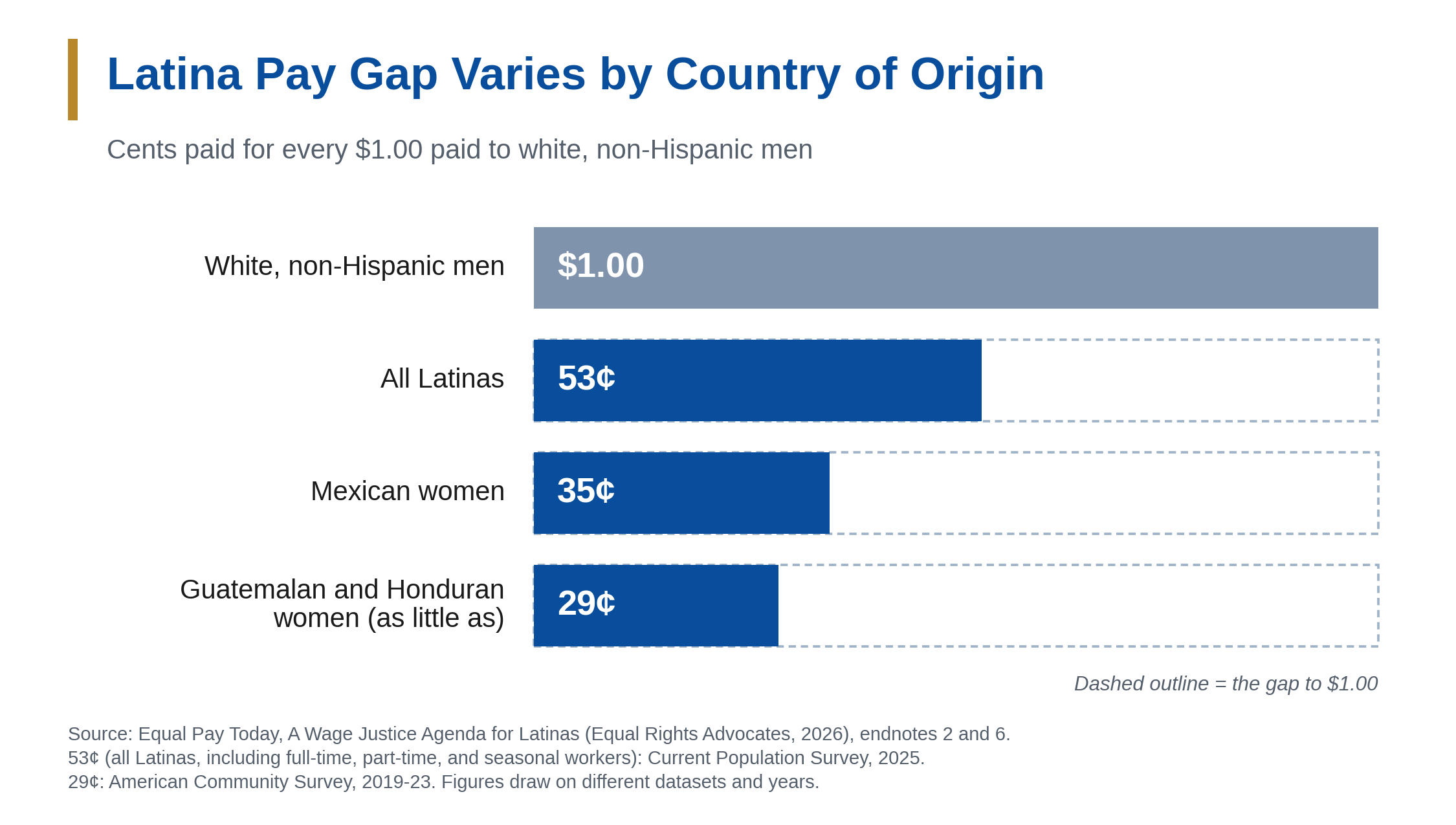
Latinas hold political power and are leading drivers of the U.S. economy—as voters, workers, business owners, and spenders—while being compensated close to half of what is paid to white men. They contributed $1.3 trillion to the U.S. GDP in 2021 alone.1 Yet today, on average, Latinas—including fulltime, part-time, and seasonal workers—are still paid a mere 53 cents to every dollar paid to white, non-Hispanic men ($37,050 per year).2
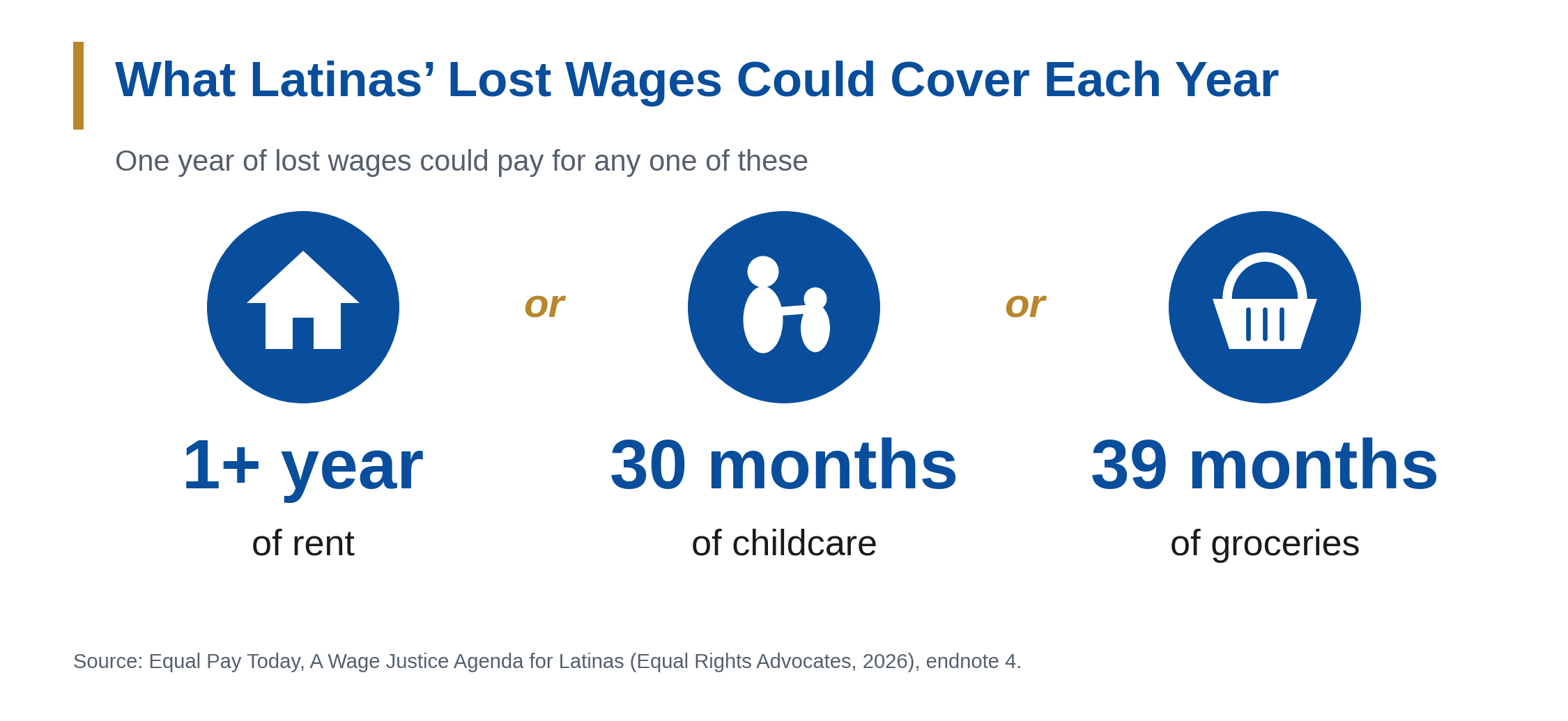
This form of wage theft robs a Latina worker of $33,370 every year or over $1 million over the course of a career.3 Annually, these lost wages could cover over one year’s rent, 30 months of childcare, or 39 months of groceries.4 This substantial loss in wages serves as one of the largest barriers to establishing basic economic security and building economic power.
These sizable disparities are, at least in part, attributed to intersectional discrimination based on gender, race, ethnicity, and immigration/socio-economic status.5 The pay gap for Latinas can vary significantly based on country of origin, with Guatemalan and Honduran women making as little as 29 cents on the dollar and Mexican women making only slightly more at 35 cents on the dollar.6
Notably, lack of immigration status or work authorization disproportionately pushes many Latinas into industries where they face some of the most severe and dangerous working conditions, including risk of sexual exploitation, with little pay, no time off, and few to no benefits. These existing vulnerabilities are only exacerbated by the federal administration’s inhumane assaults on immigrant communities. Below is an overview of key contributors and barriers:
Broad Geographic Disparities
Latinas face unconscionable disparities across the United States. In 2023, for example, Latinas were paid less than half of what white men were paid in 28 states, where they earned less than $23,000 annually—below the federal poverty line for a single adult with two children.7
“ Latinas show up every single day. We show up in classrooms, hospitals, fields, offices, hotels, in our communities, at home, and beyond. Yet we have to work more than nine extra months to earn what a white, non-Hispanic man earned the year before. That gap isn’t just a statistic—it’s tangible, real hard-earned money missing from our pockets for food, housing, quality education, healthcare access, and opportunities to get ahead.”
– Karla Pineda
Executive Director, Labor Council for Latin American Advancement (LCLAA)
Occupational Segregation & Poverty Wages
Latinas are more likely to earn poverty wages. They remain overrepresented in the lower-wage workforce, making up only 8.8 percent of the overall workforce yet 17.3 percent of the lower-wage workforce. In 2024, one quarter of full-time Latina workers were concentrated in these professions, including food preparation, restaurant and hospitality work, commercial cleaning, health care, elder care, and domestic work.8 Despite the fact that Latina immigrants hold a wide range of occupations in their home countries, they are typically funneled into these low-wage service occupations when they arrive in the United States.9 These industries are often more likely to have more variable incomes, unpredictable work schedules, fewer benefits, fewer workplace protections, and little to no time off. Latinas are also more susceptible to wage theft in these industries. Studies show that they are 88 percent more likely than white women to suffer a minimum wage violation, and the risk is only exacerbated for noncitizen Latinas.10
Closer Look: Equal Pay Today’s Platform for Change
Equal Pay Today (EPT), a project of Equal Rights Advocates (ERA), is a wage justice initiative uniting over 50 national, regional, state, and tribal organizations to eradicate pay disparities harming women and other workers based on characteristics including gender, race, ethnicity, LGBTQ status, and disability. With a focus on low-paid workers and communities of color, Equal Pay Today is building a wage justice movement for all through policy advocacy, movement building, research, and strategic legal enforcement. Equal Pay Today’s comprehensive Policy Agenda addresses various contributors to the gap, including pay inequity and pay secrecy, lack of caregiver supports and caregiver bias, occupational segregation, poverty wages, and workplace discrimination. Since its founding, Equal Pay Today has supported successful pay equity legislation in 44 states, helped lead advocacy in support of successful federal actions, and built upon these wins during the most recent legislative sessions across the country.
Breadwinners & Caregivers Without Benefits
45 percent of Latina mothers are breadwinners in their households.11Meanwhile, Latinas are more likely to serve as primary caregivers to children and elderly family members.12Latina mothers often face larger barriers in supporting their families and providing care because they often carry out employment without critical benefits. Notably, only 18 percent of Latinas are in jobs with employer-sponsored benefits and more than half cannot earn a single paid sick day.13In a 2024 survey, 70 percent of Latinas with children under 12 reported not having childcare in a four-week period; of those women, almost a third reported having left or lost a job recently.14A number of immigrant Latina women, who are mostly of childbearing age, reported that pregnancy led directly to a loss of employment.15Lack of access to childcare, paid time off, and paid family leave exacerbates income inequality and increases the risk of poverty.
High Risk of Poverty
In 2024, 20.2 percent of Latina mothers were living below the federal poverty line while over half (53.7 percent) were near the poverty line.16While the risk of poverty is higher for Latina mothers, Latinas generally are at high risk of living at or close to the poverty line. In 2024, 12.6 percent were living below the federal poverty line, and 38.3 percent were near the poverty line.17These rates are likely to increase due to the impacts of immigration enforcement; restrictions enacted under HR 1, the so-called “One Big Beautiful Bill Act,” to narrow eligibility for SNAP, Medicaid, Medicare, ACA premium tax credits, and the Child Tax Credit; and implementation of the public charge rule, which is estimated to lead to a disenrollment of roughly 1.3 million people in need due to potential citizenship eligibility consequences of being enrolled in public benefit programs.18
Disparities Across Industries
The wage gap for Latinas persists despite differences in education, occupation, and immigration status. Even when Latinas occupy higher-paying managerial roles, they still only earn 79.4 percent of their male Latino counterparts and 64 percent of white men.19
Educational Barriers
Latinas still face substantial barriers to educational attainment. While Latinas have doubled their college attainment,20this growth has not been accompanied by parallel growth in wages. Over half of Latino students work more than 30 hours weekly to support the costs of their education.21For Latina students specifically, the pressures of being a student can be compounded with familial responsibilities.22
Unemployment
Despite maintaining a high labor force participation rate, Latinas are more likely to face unemployment than white men.23
Closer Look: The federal administration’s inhumane attacks on immigrant communities are exacerbating longstanding drivers of inequity for Latinas.
These assaults include:
- widespread and ongoing workplace raids;
- mass arrests, detention, and deportations;
- efforts to limit access to legal representation;
- denial and revocation of work authorizations;
- restrictions enacted under HR 1 to narrow eligibility for SNAP, Medicaid, Medicare, ACA premium tax credits, and the Child Tax Credit;
- implementation of the public charge rule to penalize immigrants from accessing essential public benefits for which they are eligible;
- efforts to revise the Census to exclude immigrant communities and to stop collecting race and ethnicity data;
- denial of federal minimum wage and overtime protections for home health aides and personal care aides.
Collectively, these actions have created a terrorizing environment that has forced immigrant workers to go into hiding, exit the workforce, face even higher rates of workplace retaliation and threats, and refrain from reporting workplace violations. These factors are worsening existing economic insecurity. For immigrant women, these fears are impacting where, whether, and how they work.
Closer Look: Economic Mobility and the Democratic Process
Latinas hold political power in the United States. At the national level, they constitute 12% of registered women voters and in the 2020 presidential election, 68 percent of registered Latinas voted.24 Today Latinas care about the rising cost of living, including the cost of groceries, rent, health care, utilities, and childcare.25 Even though 2026 has seen a record number of Latinas in Congress and state legislatures, political underrepresentation persists at every level of office.26 Civic engagement that prioritizes economic security and power—through voting, running for office, serving as elected officials, and increasing representation in political leadership—is a critical lever for Latinas to be heard and to build political power, economic security, and wealth.
Report continued below footnotes
- Marlene Orozco, Latina Wealth in America, Latino Prosperity (Oct. 2025), https://img1.wsimg.com/blobby/go/61b50d9b-dc47-41b7-8354-5aebc0b00764/Latina%20Wealth%20in%20America%20Breaking%20Barriers%20Bui.pdf.
- For full-time, year-round workers, the wage gap is 60 cents for every dollar paid to white, non-Hispanic men. American Association of University Women, The Gender Pay Gap (Feb. 2026), https://www.aauw.org/issues/economic-security/pay-gap/; Center for American Progress, RELEASE: New CAP Analysis Finds Gender Wage Gap Narrowed in 2025, While Affordability Challenges Deepen for Women (Sept. 15, 2026), https://www.americanprogress.org/press/release-new-cap-analysis-finds-gender-wage-gap-narrowed-in-2025-while-affordability-challenges-deepen-for-women/; Kate Bahn and Miranda Peterson, The Gender Wage Gap Improved in 2025, but Black and Latina Women Were Left Behind, Institute for Women’s Policy Research (Sept. 16, 2026), https://iwpr.org/articles/the-gender-wage-gap-improved-in-2025-but-black-and-latina-women-were-left-behind/; National Partnership for Women and Families, Wage Gap Narrows for Working Women Overall, but Progress Is Uneven (Sept. 15, 2026), https://nationalpartnership.org/news_post/wage-gap-narrows-for-working-women-overall-but-progress-is-uneven/; National Women’s Law Center, NWLC Resources on Poverty, Income, and Health Insurance in 2025 (Sept. 17, 2026), https://nwlc.org/resource/nwlc-resources-on-poverty-income-and-health-insurance/.
- National Partnership for Women and Families, Latina Women and the Wage Gap (Oct. 2026), https://nationalpartnership.org/report/latinas-wage-gap/; Ashir Coillberg, Because of the Wage Gap, Latinas Stand to Lose Nearly $1.3 Million Over a 40-Year Career, National Women’s Law Center (Sept. 2024), https://nwlc.org/wp-content/uploads/2023/09/2024-Latina-EPD-9.24.2024v2.pdf.
- National Partnership for Women and Families, Latina Women and the Wage Gap (Oct. 2026), https://nationalpartnership.org/report/latinas-wage-gap/.
- Donals E. Eggarth, Sheli C. Delaney, Michael A. Flynn, C. Jeff Jacobson, Work Experiences of Latina Immigrants: A Qualitative Study, National Library of Medicine (Feb. 2012), https://pmc.ncbi.nlm.nih.gov/articles/PMC4560686/.
- Justice for Migrant Women, Latina Equal Pay (2026), https://justice4women.org/latina-equal-pay#3979d87f-40bc-4527-be88-3e2e26335a9c
- Martha Susana Jaimes, Miranda Peterson, Ariane Hegewisch, Latinas Paid Just 54 Cents on the Dollar in 2024, and Pay Equity is More Than 150 Years Away, Institute for Women’s Policy Research (Sept. 30, 2025), https://iwpr.org/articles/latina-equal-pay-day-2025/.
- Id. at 6.
- Donals E. Eggarth, Sheli C. Delaney, Michael A. Flynn, C. Jeff Jacobson, Work Experiences of Latina Immigrants: A Qualitative Study, National Library of Medicine (Feb. 2012), https://pmc.ncbi.nlm.nih.gov/articles/PMC4560686/.
- Janice Fine, Daniel J. Galvin, Jenn Round, and Hana Shepherd, Maintaining effective U.S. labor standards enforcement through the coronavirus recession, Washington Center for Equitable Growth (Sept. 2020), https://equitablegrowth.org/wp-content/uploads/2020/09/090320-labor-enforcement-report.pdf.
- National Partnership for Women and Families, Latina Women and the Wage Gap (Oct. 2026), https://nationalpartnership.org/report/latinas-wage-gap/.
- Lisette Orellana Engel, An invisible but powerful economic engine, the 1.3 trillion impact of U.S. Latinas, Unidos US (March 26, 2026), https://unidosus.org/blog/2026/03/26/an-invisible-but-powerful-economic-engine-us-latinas/.
- Unidos US, Making Jobs Work for Latinas (Sept. 2023), https://unidosus.org/wp-content/uploads/2023/08/unidosus_makingjobsworkforlatinas.pdf.
- National Women’s Law Center, Child Care Problems Disproportionately Impacted Black Women, Latinas, Disabled Women, and Those with Lower Household Incomes in 2024 (Dec. 2025), https://nwlc.org/wp-content/uploads/2025/12/Child-Care-Problems-Disproportionately-Impacted-Black-Women-Latinas-Disabled-Women-and-Those-with-Lower-Household-Incomes-in-2024.pdf.
- Donals E. Eggarth, Sheli C. Delaney, Michael A. Flynn, C. Jeff Jacobson, Work Experiences of Latina Immigrants: A Qualitative Study, National Library of Medicine (Feb. 2012), https://pmc.ncbi.nlm.nih.gov/articles/PMC4560686/.
- Sarah Javaid, Hard Work Is Not Enough: Women in Low-Paid Jobs, National Women’s Law Center (June 2026), https://nwlc.org/wp-content/uploads/2023/07/Hard-Work-Is-Not-Enough-Women-in-Low-Paid-Jobs-1.pdf.
- Id. at 3.
- Mark H. Greenberg, A growing effort to restrict immigrants’ access to public benefits, The Brookings Institute (July 24, 2026), https://www.brookings.edu/articles/a-growing-effort-to-restrict-immigrants-access-to-public-benefits/.
- Martha Susana Jaimes, Miranda Peterson, Ariane Hegewisch, Latinas Paid Just 54 Cents on the Dollar in 2024, and Pay Equity is More Than 150 Years Away, Institute for Women’s Policy Research (Sept. 30, 2025), https://iwpr.org/articles/latina-equal-pay-day-2025/.
- Lisette Orellana Engel, An invisible but powerful economic engine, the 1.3 trillion impact of U.S. Latinas, Unidos US (March 26, 2026), https://unidosus.org/blog/2026/03/26/an-invisible-but-powerful-economic-engine-us-latinas/.
- Excelencia in Education, Latinos in Higher Education: 2024 Compilation of Fast Facts (April 2024), https://www.edexcelencia.org/research/publications/latinos-in-higher-education-2024-compilation-of-fast-facts.
- Id.
- U.S. Bureau of Labor Statistics, Labor Force Statistics from the Current Population Survey (Feb. 20, 2026) https://www.bls.gov/cps/cpsaat06.htm; https://nationalpartnership.org/latinas-opportunities-challenges-in-job-market-jobsday-october-2024/.
- Veronica Terriquez, Steven Carmona, and Mora Sonja Diaz, Latina Voters Can Shape the Future of American Politics, Latina Futures 2050 Lab (Oct. 15, 2024), https://latinafutures.org/wp-content/uploads/2024/10/LFL-Latina-Voters-Brief_Rev10.15.pdf.
- Isabelle Valdez, Audrey Kearny, Ashley Kirzinger, and Liz Hamel, Polling Insight: 4 Key Takeaways About Hispanic Women Voters Nationally and in Arizona, KFF (July 17, 2024), https://www.kff.org/womens-health-policy/polling-insight-4-key-takeaways-about-hispanic-women-voters-nationally-and-in-arizona/.
- Dittmar, Kelly, Kira Sanbonmatsu, and Paru Shah, Latinas in Politics, Center for American Women and Politics, Eagleton Institute of Politics, Rutgers University (2026), https://cawp.rutgers.edu/research-analysis/gender-and-politics-research-hub/research-Inventory/latinas-politics.
A Comprehensive Wage Justice Agenda for Latinas
“For more than a decade we have used our collective power to sound the alarm about the gaping pay gap that Latinas are facing in the workplace. It is important for us to remember that even though this pay gap persists and, is even worse for some working Latinas, we continue to find the way to create businesses, to contribute and to lead across industries and sectors. This is why our theme of Power.Pay.Progress is so important. Latinas are powerful, we are pushing for improved economic policies, as well as for our financial security, and in spite of the persistent pay gap we have been able to make progress for ourselves, our families, and for the country.
– Mónica Ramírez
President and Founder of Justice for Migrant Women
The persistent and sizable pay gap for Latinas is not a coincidence. The gap is the result of discriminatory structures that exploit the labor of Latinas to grow the economy while segregating them into occupations that pay poverty wages without benefits. To advance healthy economic growth, these structures need to be reformed so that they no longer exclude Latinas from opportunities to build economic security and wealth.
Despite overlapping barriers, Latinas are powerful and have the solutions to address these gross injustices. Over the past decade, Equal Pay Today has built community power behind policy reforms that address the key contributors to the pay gap harming Latina workers. These solutions, set forth in our Policy Agenda, not only defend against a hostile federal administration; they are paving a new vision for valuing the labor of Latinas and other women. This playbook of legislative solutions can and should be replicated across states towards the goal of building long-term consensus to codify these protections in federal legislation.
A comprehensive wage justice agenda for Latinas includes:
-
Confronting systemic discrimination barring many Latinas from accessing equal opportunity.
The EPT Policy Agenda works to preserve and advance key tools to address systemic discrimination. This includes: opposing the Equal Employment Opportunity Commission’s (EEOC’s) attempt to eliminate the longstanding EEO-1 data collection, which is essential to anti-discrimination enforcement, and strengthening state protections to codify disparate impact liability. Disparate impact protections allow employees to challenge workplace practices that appear neutral on their face, but result in biased outcomes for women, people of color, and other protected groups.
-
Tackling job segregation into low-wage industries.
Latinas face high rates of occupational segregation that has pushed them into essential yet undervalued occupations that severely limit their earnings and prevent them from achieving basic economic security. The EPT Policy Agenda sets forth a roadmap to raise wages in underpaid and undervalued industries where women and workers of color are disproportionately represented. This includes: fighting to preserve federal data collections that are critical for identifying trends in occupational segregation and advocating for the Fair Pay Act, a federal bill that would require employers to provide equal pay to employees for comparable or equivalent work helping to address wage differentials due to occupational segregation. Equally important is the creation of pathways for Latinas to enter male-dominated higher paying industries with union protections though initiatives like Equal Rights Advocates’ Infrastructure Pathways Project and the advocacy of the National Taskforce on Tradeswomen’s Issues, a project of ERA.
Closer Look: Workplace Retaliation and Immigration-Related Coercion
EPT supports anti-retaliation protections that directly target employer retaliation based on immigration status. These laws exist in some states and are growing. In 2019, New York enacted a law that makes it illegal for employers to retaliate against workers by contacting or threatening to contact immigration authorities or law enforcement based on an employee asserting their workplace rights or filing a complaint. This year, Equal Rights Advocates helped enact AB2495 in California, which prohibits workplace retaliation based on immigration status, prohibiting California employers from using immigration-related threats to discourage workers from asserting their rights.
“ For Latinas, that’s an incredible opportunity… a union apprenticeship and a union construction career really allowed me to have opportunities that I couldn’t make for myself in another situation.
– Crystal Herrera
IBEW Local 11 Electrician & Cable Splicer
-
Promoting equal pay by strengthening pay equity laws, implementing salary history bans, and prohibiting retaliation.
Latinas face discrimination based on intersecting factors that drive hiring biases and unequal treatment on the job. These dynamics limit advancement, thwart mobility, and bring down wages. To address these inequities, Equal Pay Today advocates for state and federal legislation to close loopholes in existing pay equity laws, mandate equal pay for equal or substantially similar work, and prohibit the use of prior salary in hiring and salary-setting. This includes ongoing advocacy to enact the Paycheck Fairness Act and support that has resulted in dozens of pay equity legislative wins at the state level.
-
Demanding pay transparency to empower workers with leverage and hold employers accountable.
Secrecy around pay prevents Latinas from identifying gender or race-based wage disparities and advocating for fair pay. When pay practices remain secret, employers can maintain discriminatory practices absent scrutiny. Equal Pay Today supports passage of the federal Salary Transparency Act and leads efforts to support states to enact pay transparency laws. As of 2026, at least 19 states have some form of pay transparency law.
-
Establishing caregiver protections and reducing caregiver penalties.
Latinas are disproportionately tasked with unpaid caregiving responsibilities while being denied essential benefits to allow individuals to realistically work and care for their families. This can cause workplace interruptions that result in women receiving less pay, being denied promotions, and facing barriers to advancement in their careers. Wage justice requires caregiver protections, including affordable childcare, paid family leave, and paid sick days. Equal Pay Today supports efforts to enact the federal FAMILY Act to establish a national paid family and medical leave program; the Healthy Families Act, to establish paid sick leave; and the Job Protection Act and the Caring for All Families Act to expand existing leave protections nationwide. Equal Pay Today also supports state legislative efforts to achieve these protections.
“ I make dollar for dollar, cent for cent, the same amount as every man that I work next to.
– Celina Barron
IBEW Local 11 Journey Level Inside Wire Electrician & Program Manager at ERA
-
Raising the wage floor, eliminating poverty-wages, and challenging wage theft.
Latinas face high poverty rates, and too many Latinas earn poverty wages. Wage justice cannot be achieved without addressing the inequities created by job segregation and its role in driving the wage gap without increasing the wage floor. Equal Pay Today supports federal and state legislation to increase the minimum wage, eliminate the tipped minimum wage, and preserve and expand funding for public benefits.
-
Creating robust workplace protections against sexual and other forms of harassment and discrimination that drive and exploit economic vulnerability.
Latina workers—particularly low-wage, migrant, and undocumented employees—face high rates of severe workplace sexual harassment, coercion, and labor exploitation. Sexual harassment has broad economic consequences that drive pay inequity, imposing trauma, forcing women out of their jobs, impacting job performance, limiting job opportunities and advancement, and often resulting in further discrimination and retaliation. Equal Pay Today supports the federal BE HEARD in the Workplace Act, which would strengthen the law to better address and prevent workplace discrimination and harassment, including by covering all workers, regardless of employer size, and eliminating the tipped minimum wage, which places tipped workers at greater risk of harassment by customers. At the state level, Equal Pay Today supported bills to strengthen protections against workplace harassment in Arizona, California, Georgia, and Maryland, with recent success in California.
-
Strengthening enforcement and challenging attacks on enforcement infrastructure.
Equal Pay Today strongly opposes the gutting of our nation’s civil rights enforcement agencies and other critical programs and engages in robust federal defensive work to stem the current administration’s attempts to dismantle existing public benefits, civil rights and labor protections, and enforcement. This includes advocacy to safeguard and restore federal enforcement agencies like the Office of Federal Contract Compliance Programs (OFCCP) and the Equal Employment Opportunity Commission (EEOC), to preserve critical data collections carried out by the EEOC and the U.S. Census Bureau, and to oppose the rescission of critical guidance and federal regulations clarifying enforcement of core civil rights workplace protections.
ERA Partner Spotlight
Justice For Migrant Women Issues Critical Guide on Healthy and Safe Workplaces for Migrant and Rural Women
Justice for Migrant Women, an EPT member and core partner, champions migrant and rural women’s right to live and work with dignity, and without fear of sexual violence. The organization is in community with women who migrate to work across international borders, around regions, or within states as well as rural women and has an emphasis on women from historically marginalized communities or who are employed in low paying jobs. Women migrate for many reasons, including economic insecurity, gender-based violence, and the impacts of climate change.
Despite the personal and historical trauma they too often face, migrant and rural women are powerful and have long worked to prevent, address, and overcome these issues. Justice for Migrant Women works alongside them to amplify their voices, fight for their rights, and shift culture to recognize their expertise, dignity, and strength.
Working closely with migrant women worker leaders and allies, the organization is creating educational tools for migrant women to educate and organize around their rights based on their lived realities. Most recently, Justice for Migrant Women released a new guide (in English and Spanish)— Healthy and Safe Workplaces: A Guide for Migrant and Rural Women—that focuses on workplace discrimination experienced most acutely by migrant and rural women. You can view the new guide and learn more about their work here.
| To Cite This Report
Khawaja, Seher, with research support by Eva Pruitt. “A Wage Justice Agenda for Latinas: 2026 Latina Equal Pay Day.” Equal Rights Advocates, October 2026. https://bit.ly/4ATjiwx |